Treg Therapy for Lyme: When the Infection Is Gone but You're Still Sick
If you cleared the infection — even with whole-body hyperthermia — and still feel terrible, you are not crazy and you are not out of options. Here's the piece almost no one explains: sometimes the problem isn't the bug anymore. It's an immune system that never stood down.
I want to talk to a very specific person today. You did the hard thing. You found a real diagnosis, you fought for treatment, maybe you even traveled across the world for whole-body hyperthermia. The infection was addressed — and yet here you are, still unwell, still inflamed, still collecting strange new symptoms, wondering what on earth you did wrong.
You didn't do anything wrong. My husband, James, was exactly that person. And what finally helped him is something I rarely see explained clearly, so I want to lay it out for you here.
Key takeaways
- Clearing the infection is only half the story. After years of chronic Lyme, the immune system can stay stuck in overdrive even once the bacteria are gone.
- Regulatory T cells (Tregs) are the immune system's "brake." When they're not doing their job, the body can overreact — driving inflammation, autoimmune-type flares, allergies, and new sensitivities.
- Treg therapy targets dysregulation, not infection. It aims to help the immune system govern itself again.
- It can be especially relevant after hyperthermia. If you cleared Lyme but are still sick, an overreactive immune system — not lingering infection — may be why.
- It uses your own cells (autologous). The therapy is made from your own T-regulatory cells, so there's nothing foreign for your body to reject.
- This is one family's story, not a promise. Results vary, and any treatment or medication change belongs with your medical team.
Quick answer
What is Treg therapy for chronic Lyme disease, and how does it work?
Treg therapy for chronic Lyme disease is a cell therapy that targets immune dysregulation rather than the infection itself. Regulatory T cells — Tregs, the FOXP3+ "peacekeeper" cells that tell the immune system when to stand down — are often depleted or dysfunctional after years of chronic Lyme, leaving the immune system stuck in overdrive even once the bacteria are cleared. In autologous Treg therapy, cells derived from the patient's own blood are given across a short series of applications to help restore that self-regulation — teaching the immune system to govern itself again rather than suppressing it. It is an emerging, experimental approach — not an FDA-approved standard treatment for Lyme — and the supporting evidence is early and largely patient-reported, so it is used as one part of an individualized plan under medical supervision.
My husband's story: cured of the infection, still sick
In 2017 our whole family went through extreme whole-body hyperthermia in Germany. For my husband, James, it cleared the Borrelia — follow-up testing and darkfield microscopy confirmed it. By the numbers, he should have been well.
But he wasn't. In the years that followed, his body seemed to turn on itself. He developed rheumatoid arthritis. He broke out with rosacea he could only control with ongoing antibiotics. He picked up allergies he'd never had. He became gluten intolerant. One by one, his immune system was overreacting to more and more things — attacking his own joints, flaring his skin, treating ordinary foods like threats. The infection was gone, but he was arguably more dysregulated than ever.
Then he received autologous regulatory T-cell therapy. I'm not going to dress it up — I'll just tell you what happened for him:
Watching James, I finally understood: the infection was never the whole story. His immune system had forgotten how to stand down — and that was the part keeping him sick.
Please hear me clearly: he made every one of those medication changes with medical guidance, not on a whim, and what happened for him is not a guarantee for anyone else. I'm sharing it because our family spent years not knowing this category of help even existed.
The gap hyperthermia leaves behind
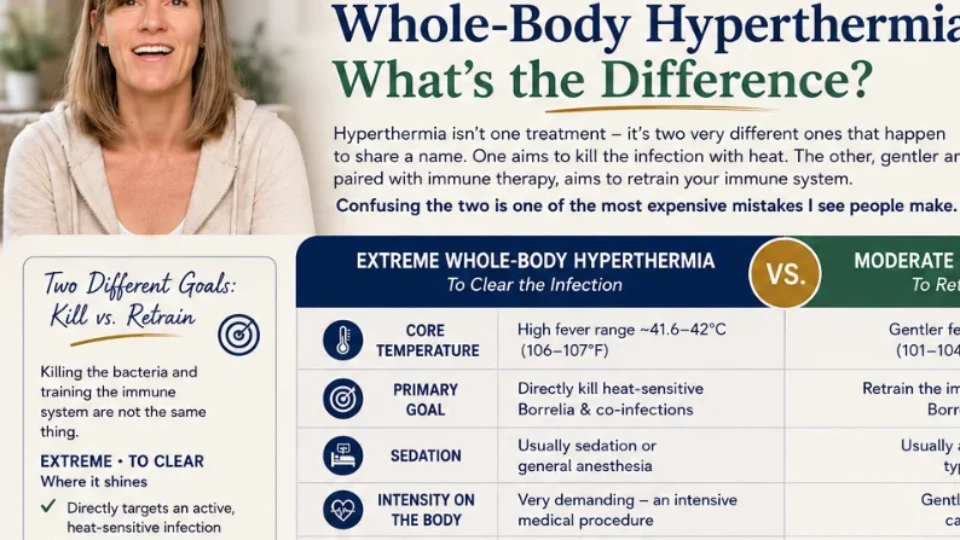
Whole-body hyperthermia is aimed at one job: clearing infection. When it works, it can work beautifully — for James, it did. But killing bacteria and resetting an immune system are two completely different things, and nothing about the heat automatically teaches a worn-out, overreactive immune system how to calm down.
After years of chronic infection, the immune system can get stuck in a state of high alert. Even once the trigger is gone, it keeps firing — like a smoke alarm that won't reset after the fire is out. That's the gap. And if no one addresses it, you can clear your Lyme and still feel awful, which is one of the most demoralizing places to be after everything you've been through.
What are regulatory T cells?
In plain language: regulatory T cells — "Tregs" — are the peacekeepers of your immune system. Their whole job is to say "enough." They tell the immune response when to stand down so your body doesn't attack its own tissues or overreact to harmless things like food, pollen, or your own skin.
When Tregs are doing their job, you barely notice them — that's the point. When they're not, the brakes are off. The immune system runs hot, and you get exactly the kind of picture James had: autoimmune flares, inflammation, allergies, sensitivities that seem to multiply.
What is Treg therapy?
Treg therapy is an approach aimed at restoring that regulation — helping the immune system find its "brake" again. Crucially, it isn't aimed at an infection. It's aimed at the dysregulation itself: the overreactive, misguided immune behavior that can linger long after the bug is gone.
That's why it can be such a different conversation from the treatments most Lyme patients have already tried. If you've spent years attacking infection after infection and still aren't well, this is a fundamentally different target. It's also the reason I felt it deserved its own page, separate from the hyperthermia guide — because it answers a question hyperthermia alone can't.
Why "autologous" matters
The version I'm talking about is autologous Treg therapy — and that word matters more than it looks. Autologous means it's made from your own T-regulatory cells. Nothing foreign is being introduced, so there's nothing for your body to reject. In the program I'm most familiar with, a course is a small series of applications — three — using cells derived from you, to help your own immune system relearn how to regulate itself.
And to be clear about what it is not: this isn't about suppressing your immune system or shutting it down. It's about teaching it to work correctly again — to fire when it should and stand down when it shouldn't.
Why it can come first
Here's a reframe that took me a long time to understand: a dysregulated immune system doesn't respond to other therapies the way it's supposed to. If your immune system is stuck over-firing, you can throw good treatment after good treatment at it and never get the response you'd expect — because the system receiving it can't govern itself.
That's why, in the program I advise, restoring Treg function is often treated as a foundation — done before deeper pathogen-clearing work, not after. Get the immune system governable first, and every therapy that follows lands on a body that can actually use it. It's standalone, but it also tends to improve how you respond to whatever comes next.
Who it tends to help
I think of this especially for one group of people: those who had Lyme, received treatment — including whole-body hyperthermia — and are still sick, and don't understand why. If your infection was addressed but your body still feels like it's at war with itself, immune dysregulation is worth understanding.
The pattern shows up beyond Lyme, too. This therapy tends to be considered for people with chronic Lyme, Bartonella, Babesia, and other tick-borne co-infections — especially when the immune system feels like it's overreacting rather than fighting correctly. The same regulatory depletion can show up in conditions like long COVID, mold illness / CIRS, and chronic EBV, which is why those patients are sometimes a fit too.
More broadly, the people I talk to who explore this tend to be living with signs of an immune system that's overreacting rather than under-fighting. That distinction matters, and it's exactly the kind of thing to sort out with a qualified medical team rather than guessing at on your own.
Signs your immune system may be dysregulated
None of these prove anything on their own — but if several feel familiar after your infection was treated, they're worth raising with your doctors:
- New or worsening autoimmune-type problems (joint pain, rheumatoid arthritis, thyroid issues).
- Skin flares like rosacea, eczema, or rashes that won't settle.
- New allergies or reactions you never used to have.
- Food sensitivities — suddenly reacting to gluten, dairy, or foods you tolerated for years.
- Persistent inflammation and feeling "reactive" to everything — foods, smells, supplements, stress.
- Being told your infection markers look better, yet you still feel unwell.
How it fits with hyperthermia
I don't see this as hyperthermia versus Treg therapy — I see them as answering different questions. Hyperthermia goes after the infection. Treg therapy goes after the dysregulation the infection left behind. For someone earlier in their journey, a newer approach pairs moderate hyperthermia with Treg therapy, with the goal of both calming the immune system and helping it learn to recognize Borrelia going forward. If you want the full picture on the heat side of things, I cover it in my complete guide to whole-body hyperthermia.
For people who already had extreme hyperthermia in the past and never fully recovered, Treg therapy can be the missing piece they didn't know to look for — the answer to "where did that treatment go, and why am I still sick?"
Watch: my honest recovery after hyperthermia
Because this is exactly the gap — feeling improved but not fully well after hyperthermia — I documented my real, long-term recovery in a series of honest updates over many months. If you're living the "treated but still sick" chapter, this may help you feel less alone:
Or watch the full playlist on YouTube.
What the program typically includes
Specifics vary by clinic and by you, but in the autologous Treg program I'm involved with through Lyme Re-code, here's the shape of it:
What's included
- 3 autologous Treg cell therapy applications
- Initial bloodwork and medical evaluation
- Epigenetic testing to personalize treatment
- Daily functional-medicine physician oversight
- Clinical nutritionist consultation
What patients typically notice
- Reduction in inflammatory symptoms
- Fewer flare-ups
- Improved tolerance to other treatments
- A more stable, balanced immune response
- Gradual improvement in energy and well-being
Details reflect the program as I understand it and can change — always confirm current specifics directly with the clinic. See the full program at lymeimmunotherapy.com →
This 8-day Treg program is actually Step 1 of a larger, sequenced approach — for higher inflammatory burden it's followed by therapeutic apheresis and, last, systemic hyperthermia. I walk through the whole thing, and why the order matters, in my complete guide to Lyme immunotherapy.
Honest limitations
I'll always be straight with you. Treg therapy is not a cure, it isn't right for everyone, and it doesn't erase the need for qualified medical care — it's best thought of as one part of an individualized plan. His results were dramatic, but results genuinely vary from person to person, and what your body needs may be different from what his did. Anyone promising you a guaranteed outcome is someone to be cautious of.
And once more, because it matters most: the medication changes I described were made with his care team. Please never adjust prescriptions on your own based on anything you read here.
Questions to ask
- Are my remaining symptoms more consistent with ongoing infection, or with immune dysregulation?
- What does this therapy actually target, and what should I realistically expect?
- How does it fit with the treatment I've already had?
- What does the full plan around it look like — preparation, support, follow-up?
- Can I speak with someone who has been through it?
That last question is the one I can help with directly — because my own family has been through it.
Where to go from here
If you cleared your Lyme and you're still sick, I hope this gave you a new door to try — and the relief of knowing there might be a reason that makes sense. You're not imagining it, and you're not stuck just because one treatment didn't finish the job.
When you're ready, let's talk. There's no cost and no pressure — just someone whose own family walked this exact road, from "cured but still sick" to genuinely better.
Treg therapy FAQ
Treg therapy targets immune dysregulation rather than the infection itself. Regulatory T cells — Tregs, the FOXP3+ "peacekeeper" cells that tell the immune response when to stand down — are often depleted after years of chronic Lyme, leaving the immune system stuck in overdrive even once the bacteria are cleared. The form I focus on is autologous: cells made from your own blood, given across a short series of applications to help restore that self-regulation — teaching the immune system to govern itself again rather than suppressing it. It's an emerging, experimental approach — not an FDA-approved standard treatment for Lyme — with early, largely patient-reported evidence, so it belongs in an individualized plan under medical supervision.
It may be relevant. Hyperthermia is aimed at clearing infection, but it doesn't necessarily reset an immune system that's become dysregulated after years of chronic illness. If you cleared Lyme yet still struggle with inflammation, autoimmune flares, allergies, or new sensitivities, that can be immune dysregulation rather than ongoing infection — which is what Treg therapy targets. Whether it fits you should be assessed by qualified medical professionals.
Those can be signs of an overreactive, poorly regulated immune system — which is what Treg therapy is designed to address. After years of Lyme and hyperthermia, my husband developed rheumatoid arthritis, rosacea, allergies, and gluten intolerance — and saw significant improvement after autologous Treg therapy. Results vary, and any treatment or medication change should be made with qualified medical guidance.
No. It isn't marketed as a cure. It addresses immune dysregulation rather than infection and is generally considered as one part of a broader, individualized plan. Results vary by person.
This is autologous therapy — it's made from your own T-regulatory cells, so there's nothing foreign to reject. It isn't about suppressing your immune system either; the goal is to help it regulate itself correctly again. A typical course is a short series of applications, with bloodwork, evaluation, and daily physician oversight along the way.
It tends to come up for people whose Lyme infection has been treated but who remain unwell with signs of an overactive immune system — autoimmune flares, chronic inflammation, allergies, or new sensitivities. Suitability depends on your full medical history and should be evaluated by qualified medical professionals.
References & further reading
- Centers for Disease Control and Prevention (CDC) — Lyme Disease. cdc.gov/lyme
- International Lyme and Associated Diseases Society (ILADS) — evidence-based guidelines and research. ilads.org
- MedlinePlus (U.S. National Library of Medicine, NIH) — Lyme Disease. medlineplus.gov
- Johns Hopkins Lyme Disease Research Center. hopkinslyme.org
Medical disclaimer: This guide is for educational purposes only and reflects personal experience and general information. It is not medical advice, diagnosis, or treatment, and it does not replace consultation with a qualified healthcare professional who knows your individual history. Christina Carter is a patient advocate and educator, not a licensed medical provider. Treatments and outcomes vary from person to person, and the results described here are personal and not typical or guaranteed. Never start, stop, or change any medication except under the direction of your prescribing physician. Always consult your physician before pursuing any treatment.