
Extreme vs. Moderate Whole-Body Hyperthermia for Lyme: What's the Difference?
Hyperthermia for Lyme disease isn't one treatment — it's two very different ones that happen to share a name. One aims to kill the infection with heat. The other, gentler and paired with immune therapy, aims to retrain your immune system. Confusing the two is one of the most expensive mistakes I see people make. Here's the honest side-by-side.
When my family flew to Germany for whole-body hyperthermia, I didn't fully grasp that "hyperthermia" describes a whole family of treatments — and that the version we chose was worlds apart from the "moderate" protocol I now find myself most drawn to. If you're researching this, the single most useful thing I can do is make that difference crystal clear, because it changes everything about cost, risk, and what you can realistically expect.
Quick answer
What is the difference between extreme and moderate whole-body hyperthermia for Lyme?
Extreme whole-body hyperthermia raises core body temperature to a high fever range (around 41.6–42°C / 106–107°F) under sedation or anesthesia, aiming to directly kill heat-sensitive Borrelia and co-infections. Moderate whole-body hyperthermia uses a gentler fever-range temperature (roughly 38.5–40°C) and is usually paired with immune therapy such as Treg therapy — the goal isn't only to weaken the infection but to help the immune system recognize and respond to it. In short: extreme aims to kill the organism; moderate paired with immune therapy aims to retrain the body's defenses.
Key Takeaways
- “Hyperthermia” is two different treatments sharing a name.
- Extreme WBHT (~106–107°F, under anesthesia) aims to kill the infection directly — intensive, with strict candidacy. This is what my family did in Germany.
- Moderate WBHT (~101–104°F, awake) is paired with immune therapy to retrain a dysregulated immune system, not just kill bacteria.
- Killing the bug and resetting the immune system are different goals. Extreme clears infection but doesn’t leave you immune — my daughter was reinfected by a second tick.
- Neither is universally “better.” The right choice depends on your situation.
The side-by-side comparison
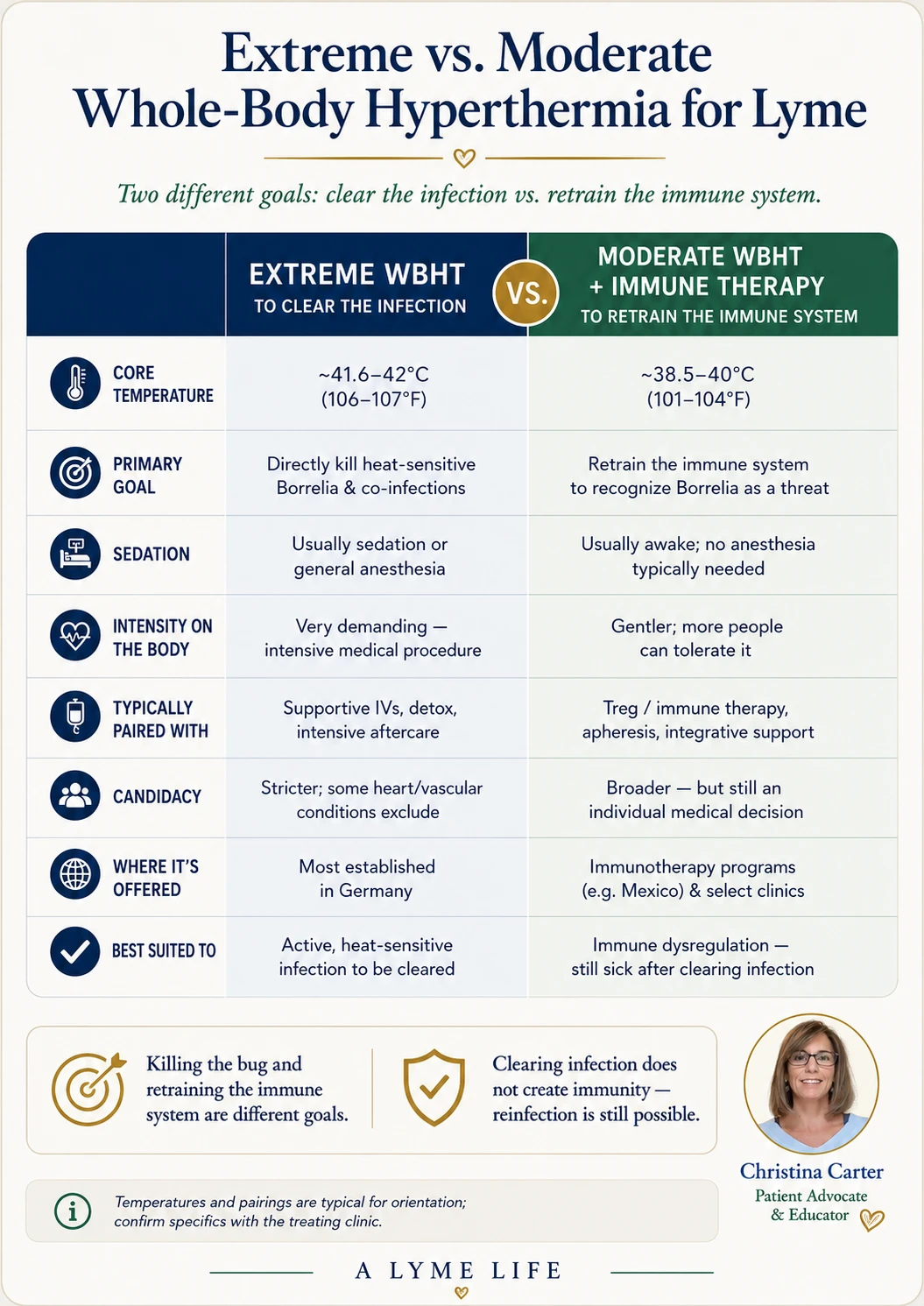
| Extreme WBHT | Moderate WBHT + Immune Therapy | |
|---|---|---|
| Core temperature | High fever range, ~41.6–42°C (106–107°F) | Gentler fever range, ~38.5–40°C |
| Primary goal | Directly kill heat-sensitive Borrelia & co-infections | Retrain the immune system to recognize the infection |
| Sedation | Usually sedation or general anesthesia | Usually awake; no anesthesia typically needed |
| Intensity on the body | Very demanding — an intensive medical procedure | Gentler; more people can tolerate it |
| Typically paired with | Supportive IVs, detox, aftercare | Treg / immune therapy, apheresis, integrative support |
| Candidacy | Stricter — some heart/vascular conditions exclude | Broader — but still an individual medical decision |
| Where it's offered | Most established in Germany | Immunotherapy programs (e.g. Mexico) & select clinics |
| Best suited to | Active, heat-sensitive infection to be cleared | Immune dysregulation — still sick after clearing infection |
Extreme vs. Moderate Hyperthermia FAQ
Hyperthermia for Lyme disease raises the body to a controlled fever-range temperature to help fight the infection — heat-sensitive Borrelia and co-infections struggle at high temperatures. It comes in two forms: extreme (high fever-range) hyperthermia, which aims to directly kill the organisms under close medical supervision, and moderate (fever-range) hyperthermia, which uses a gentler temperature and is usually paired with immune therapy to help the immune system recognize and respond to Lyme. It's a medical procedure done only in a supervised clinical setting — this guide walks through how the two differ.
Extreme raises core temperature to ~41.6–42°C under anesthesia to directly kill heat-sensitive Borrelia and co-infections. Moderate uses a gentler ~38.5–40°C, usually paired with immune therapy like Treg, to retrain the immune system. Extreme aims to kill the organism; moderate + immune therapy aims to retrain the body's defenses.
Extreme hyperthermia reaches roughly 41.6–42°C (about 106–107°F) under continuous monitoring and usually sedation. Moderate hyperthermia stays lower, around 38.5–40°C, and you're typically awake.
Moderate is generally less demanding — lower temperatures, usually no anesthesia — so more people can tolerate it. Extreme is an intensive procedure with real risks and stricter candidacy. Both require a supervised medical setting, and suitability is an individual decision.
Neither universally — they target different problems. Extreme can be powerful for reducing an active, heat-sensitive infection. Moderate + immune therapy targets the immune dysregulation that keeps some people sick after the infection clears. The right choice depends on your situation and should be made with a knowledgeable team.
Yes. Clearing an infection isn't the same as immunity — a new tick bite can reinfect you. In my own family, extreme hyperthermia cleared the infection, but my daughter was later reinfected (shown by new co-infections). It's part of why immune-focused approaches are so compelling.
References & further reading
- Centers for Disease Control and Prevention (CDC) — Lyme Disease. cdc.gov/lyme
- International Lyme and Associated Diseases Society (ILADS) — evidence-based guidelines and research. ilads.org
- MedlinePlus (U.S. National Library of Medicine, NIH) — Lyme Disease. medlineplus.gov
- Johns Hopkins Lyme Disease Research Center. hopkinslyme.org
Temperatures and pairings are typical figures for orientation, not fixed protocols; actual programs vary. Always confirm specifics with the treating clinic.
Deciding which type of program fits your situation is a bigger decision than heat alone. If you're weighing where to go, see my honest comparison of the major Lyme treatment centers.
Extreme hyperthermia, explained
Extreme (sometimes called "fever-range" or "extreme fever-range") whole-body hyperthermia raises your core temperature to the high end — around 41.6–42°C / 106–107°F — under deep medical support, usually with sedation or anesthesia. The logic is direct and physical: several of the organisms involved in Lyme and its co-infections are heat-sensitive, so a controlled, intense fever aims to weaken or kill them, break down biofilms, and rally the immune system all at once.
This is the version my family did in Germany, and I won't sugar-coat it: it's an intensive medical procedure, not a spa treatment. It's physically demanding, candidacy is stricter, and it carries real risks that make a supervised hospital setting non-negotiable. For us, though, it did what it set out to do — follow-up testing and darkfield microscopy showed the infection cleared.
Moderate hyperthermia + immune therapy
Moderate whole-body hyperthermia keeps the temperature lower — roughly 38.5–40°C, closer to a natural fever — and you're typically awake, without anesthesia. On its own that milder heat isn't trying to blast the infection into oblivion. Its power comes from what it's paired with: immune therapies like T-regulatory cell (Treg) therapy.
The aim here is fundamentally different. In chronic Lyme the immune system often isn't just tired — it's dysregulated, misfiring, and stuck in inflammation. Moderate hyperthermia used as an immune stimulus, alongside therapy that helps rebalance the immune response, aims to teach the body to recognize Borrelia as a genuine threat and respond appropriately — now and in the future.
Two different goals: kill vs. retrain
Where it shines
- Directly targets an active, heat-sensitive infection
- Powerful, well-established in hospital programs
- Can dramatically reduce infection load in one intensive course
The trade-off: demanding, higher-risk, stricter candidacy — and clearing the infection doesn't retrain the immune system or prevent reinfection.
Where it shines
- Targets immune dysregulation, not just the infection
- Gentler; awake; broader candidacy
- Aims at lasting immune recognition, not a one-time kill
The trade-off: a newer approach; the immune work is the point, so it's less about a single dramatic "kill" and more about rebalancing over time.
The reinfection lesson from my own family
Here's the part I most want you to sit with, because it reshaped how I think about all of this. For us, extreme hyperthermia worked — the infection cleared. But clearing an infection isn't the same as becoming immune to it. When my daughter Isabella was later bitten again, she was reinfected, shown by new co-infections, and had to begin treatment again.
That experience is exactly why I'm so drawn to the approach that pairs moderate hyperthermia with Treg therapy — where the aim isn't only to clear an infection, but to help the immune system actually learn from it. And if you cleared your infection but you're still sick — inflamed, reactive, collecting new symptoms — that may be immune dysregulation rather than lingering Lyme, which is a different problem calling for a different tool.
Which one is right for you?
Neither is universally "better" — they solve different problems, and the honest answer depends on you. As a rough orientation (not a prescription):
- An active, heat-sensitive infection to clear, and you're healthy enough for an intensive procedure? Extreme hyperthermia is the more direct tool.
- Cleared the infection but still sick, or looking for lasting immune recognition and something gentler? Moderate hyperthermia with immune therapy is built for that.
- Not sure — or dealing with heart, vascular, or other conditions? That's exactly the conversation to have before choosing anything.
This is where a real conversation matters more than any article. I've walked both the "clear it" and the "still sick after clearing it" roads with my own family, and I'm glad to help you understand where you might fit — with zero pressure and no cost.
Not sure which fits your situation? Let's talk it through — free →
Medical disclaimer: This article is for educational purposes only and reflects personal experience and general information. It is not medical advice, diagnosis, or treatment, and it does not replace consultation with a qualified healthcare professional. Whole-body hyperthermia is a serious medical procedure with real risks; suitability varies by individual and must be assessed by a treating medical team. Christina Carter is a patient advocate and educator, not a licensed medical provider.