Chronic Lyme disease treatment centers: an honest comparison
Choosing where to get treated may be the biggest, most expensive, most emotional decision of your Lyme journey. Here's a clear-eyed look at the main types of treatment centers — what each does best, where each falls short, and who they tend to fit — from someone who's been the patient and now walks families through this choice every week.
When my family decided to pursue treatment abroad, I remember sitting at the kitchen table drowning in browser tabs — clinic after clinic, each one sounding either like a miracle or a scam, and no way to tell which was which. I had no map. This page is the map I wish I'd had.
I'm not going to tell you there's one "best" center, because there isn't — anyone who says otherwise is selling something. What there is is a handful of genuinely different philosophies of treatment, each suited to a different situation. Understand those, and the choice gets a lot clearer.
Quick answer
What is the best chronic Lyme disease treatment center?
There is no single best center for everyone — the right choice depends on your case, your co-infections, how sick you are, your budget, and whether your priority is aggressively clearing infection or re-regulating an immune system that stays inflamed after infection. German hyperthermia clinics like Klinik St. Georg are known for extreme whole-body hyperthermia; other clinics pair moderate hyperthermia with autologous Treg immune therapy; integrative residential centers like Sanoviv offer a broad, holistic program. The most useful step is an honest consultation to match your situation to a program.
Key Takeaways
- “Treatment center” isn’t one thing. Chronic Lyme is rarely one problem, so each center leans toward killing the infection, calming the immune system, or rebuilding the body.
- Three main types: German extreme-hyperthermia clinics, moderate-hyperthermia + immune-therapy programs, and integrative residential centers.
- Clearing the infection isn’t the same as immunity. Extreme hyperthermia cleared our infection but didn’t make us immune — my daughter’s reinfection (new co-infections) proved it.
- Cost is almost always out of pocket — but The Lyme Specialist has partners who help recover part of it through insurance afterward (partial, for a percentage of what’s recovered).
- The right center matches your situation — not the most famous name.
First, know what problem you're solving
Here's the reframe that changes everything: chronic Lyme is rarely one problem, so "treatment" isn't one thing. Broadly, centers are trying to solve one (or more) of these:
- Killing the infection — clearing Borrelia and co-infections that are still active in the body.
- Re-regulating the immune system — because for many people, the bug is gone but the immune system stays stuck in a dysregulated, inflamed state and that's what keeps them sick.
- Rebuilding the whole body — detox, gut, nutrition, nervous-system regulation, and the depletion years of illness leave behind.
Most good programs touch all three, but each center leans toward one. Matching that lean to your actual situation is the whole game. (If this framing is new, my 3-layer framework for understanding chronic Lyme and my chronic Lyme treatment guide go deeper.)
1. German hyperthermia clinics
German whole-body hyperthermia
Germany Kills infectionGermany has been the global home of medical whole-body hyperthermia for decades. The best-known name is Klinik St. Georg in Bad Aibling, Bavaria — a real hospital setting where core body temperature is raised under careful medical control to target heat-sensitive Borrelia and co-infections directly. This is where my own family was treated in 2017, so I can speak to it firsthand.
These clinics are best known for extreme whole-body hyperthermia — high, tightly controlled heat aimed at killing the organisms. For us, it worked: follow-up testing and darkfield microscopy confirmed it cleared 100% of the Borrelia. It's typically wrapped into an integrative inpatient stay with antibiotics, IV therapies, and detox support.
Strengths
- Decades of hyperthermia experience
- Aggressive at clearing active infection
- Hospital setting, close medical oversight
- Used to international patients
Consider
- Extreme heat is physically demanding
- Overseas travel while very sick
- Significant out-of-pocket cost
- Clearing infection ≠ lasting immunity
Tends to fit: people with confirmed active infection who need it cleared decisively and can manage travel abroad. Read more in my Lyme treatment in Germany guide.
The one thing I learned the hard way: extreme hyperthermia cleared the infection completely, but it didn't make us immune. When my daughter was bitten again — new co-infections proved it was a new bite — she was reinfected and had to start over. That lesson is exactly why the next category exists.
2. Moderate hyperthermia + immune therapy
Moderate hyperthermia with Treg therapy
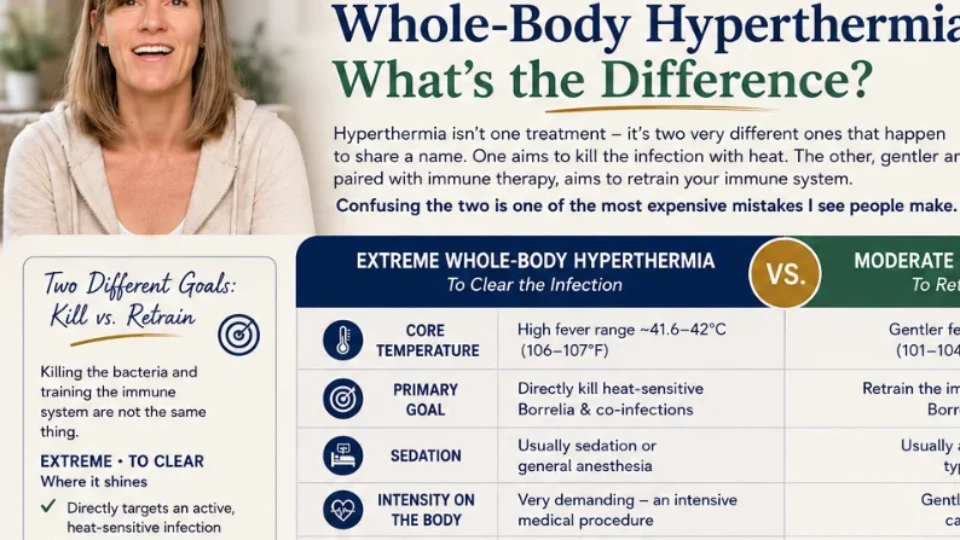
Newer model Re-regulates immunityA newer approach pairs moderate whole-body hyperthermia with autologous Treg (regulatory T-cell) therapy — using your own cells to teach the immune system to recognize Borrelia and govern its own response, rather than relying on extreme heat alone to kill everything. The goal isn't just to clear infection but to leave the immune system able to keep it in check going forward. This is the model behind Lyme Re-Code / the Immunotherapy Institute, whose clinical advisory board I serve on.
I'm biased here, so I'll be transparent: I believe in this direction precisely because of what my family went through. It directly addresses the gap that reinfected my daughter, and it's also a path for people who cleared their infection but stayed sick from a dysregulated immune system.
Strengths
- Targets immune dysregulation, not just the bug
- Gentler than extreme hyperthermia
- Uses your own cells (autologous)
- Helpful even post-hyperthermia
Consider
- Newer, still-evolving approach
- May not suit heavy active infection alone
- Out-of-pocket cost
- Best matched via consultation
Tends to fit: people whose immune system is "overreacting," or who cleared infection but are still sick. Learn more about autologous Treg therapy and the extreme-vs-moderate difference.
3. Integrative residential centers
Integrative residential programs
Mexico & elsewhere Rebuilds the whole bodyThe third model is the integrative, whole-person residential center — Sanoviv Medical Institute in Mexico is the best-known example. Rather than leading with one aggressive weapon, these programs surround you with many supportive therapies at once: medical care, nutrition, detox, dental (Sanoviv is known for this), IV therapies, and emotional and lifestyle work, all under one roof for a residential stay.
I've written an honest Sanoviv review with my candid take. The short version: this model shines at rebuilding a depleted body and treating the whole person, and it's gentler — but if you have a heavy, active infection, you may need something more targeted alongside it.
Strengths
- Whole-person, many therapies at once
- Excellent for rebuilding a depleted body
- Comfortable residential setting
- Strong nutrition and detox support
Consider
- Less targeted at deep active infection
- Broad approach, not hyperthermia-led
- Residential cost adds up
- May be one part of a longer plan
Tends to fit: people who are depleted and need whole-body rebuilding, or who want a gentler, comprehensive residential experience.
Side-by-side comparison
| German hyperthermia | Moderate + Treg | Integrative residential | |
|---|---|---|---|
| Leads with | Extreme heat to kill infection | Immune re-regulation | Whole-body support |
| Best for | Confirmed active infection | Immune dysregulation / still sick after treatment | Depletion & whole-person rebuilding |
| Intensity | High / demanding | Moderate / gentler | Gentle / supportive |
| Example | Klinik St. Georg | Lyme Re-Code | Sanoviv |
| Location | Germany | Newer model | Mexico & elsewhere |
| Addresses reinfection risk? | Clears, doesn't immunize | Aims to re-educate immunity | Supports resilience |
This table is a simplification to help you orient — real programs overlap, and the right fit is individual. Use it as a starting point for questions, not a verdict.
What about cost and insurance?
Let's be honest about the hard part: specialized Lyme treatment is a significant investment, and it's almost always paid out of pocket, since insurers rarely cover it up front. When you add travel, lodging, and a companion, the numbers are real.
Here's the piece most people don't know: The Lyme Specialist works with partners who help patients recover part of the cost through insurance after the fact. They don't recover 100%, and the partner's fee is a percentage of what they recover — but it can meaningfully soften the blow. I walk through the money side in detail in my guide to the cost of Lyme treatment.
How to actually choose
If I were sitting across from you at that kitchen table, here's what I'd say:
- Name your main problem. Active infection? Immune dysregulation? Depletion? That points you toward a category.
- Ask every clinic the same questions. My questions to ask a treatment center makes the options genuinely comparable.
- Line up a Lyme-literate doctor at home. You'll want one in your corner before and after. See how to find an LLMD.
- Be wary of guarantees. No honest center promises a cure. Run from the ones that do.
- Talk to someone who's done it. That's what I'm here for — no pressure, no sales pitch.
This is exactly the decision I help families through. If you're staring at your own wall of browser tabs right now, let's cut through it together.
Treatment center FAQ
There's no single best center for everyone — it depends on your case, co-infections, how sick you are, your budget, and whether your priority is clearing infection or re-regulating an immune system that stays inflamed. German clinics like Klinik St. Georg are known for extreme hyperthermia; others pair moderate hyperthermia with Treg immune therapy; integrative centers like Sanoviv offer a broad, holistic program. An honest consultation to match your situation is the most useful step.
Look at the treatment philosophy (does it fit your problem?), experience with chronic Lyme and co-infections, physician oversight, what's included, total cost including travel, aftercare, and how honestly they set expectations. Be wary of any clinic promising a guaranteed cure. Asking every center the same due-diligence questions makes them easy to compare.
Most specialized Lyme treatment, especially abroad, is paid out of pocket, as insurers rarely cover it up front. However, The Lyme Specialist works with partners who help patients recover part of the cost through insurance after the fact. They don't recover 100%, and the partner's fee is a percentage of what's recovered — but it can meaningfully offset the investment.
Extreme whole-body hyperthermia for Lyme isn't widely available in the US, which is why many patients travel to Germany or elsewhere for it. Some moderate hyperthermia and integrative approaches are more accessible closer to home. A consultation can help you understand what's realistically available for your situation.
References & further reading
- Centers for Disease Control and Prevention (CDC) — Lyme Disease. cdc.gov/lyme
- International Lyme and Associated Diseases Society (ILADS) — evidence-based guidelines and research. ilads.org
- LymeDisease.org — patient advocacy and education. lymedisease.org
Medical disclaimer: This article is for educational purposes only and reflects personal experience and general information. It is not medical advice, diagnosis, or treatment, and it does not replace consultation with a qualified healthcare professional who knows your individual history. Treatment centers, therapies, and their evidence vary and are not right for everyone; clinic details can change, so verify specifics directly with each center. Christina Carter is a patient advocate and educator, not a licensed medical provider. Individual results vary. Always consult a qualified, Lyme-literate physician before starting, stopping, or changing any treatment.