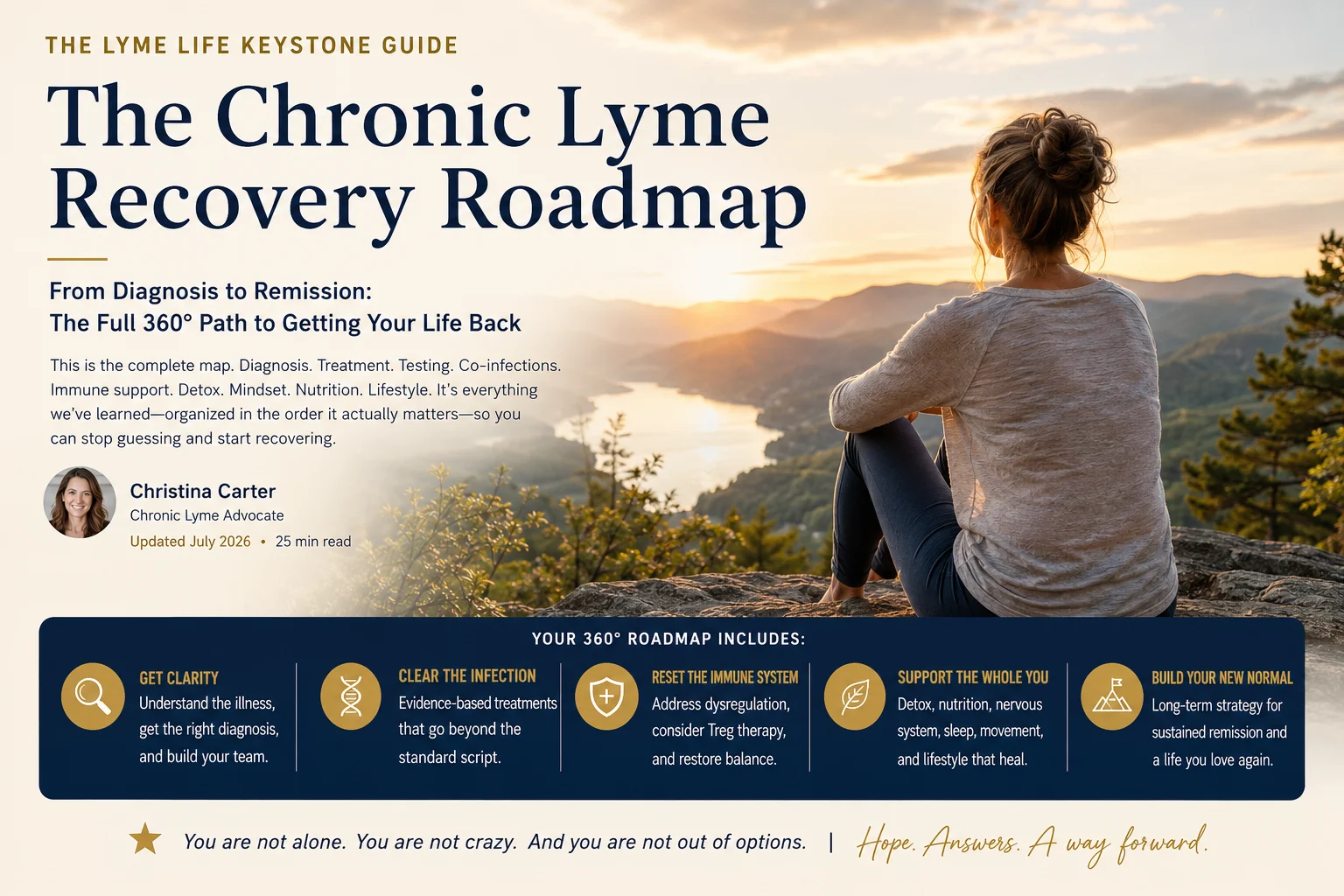
Late-Stage & Chronic Lyme: Real Treatment Options When You're Still Sick
If Lyme has stolen months or years of your life — if you were "treated" and never got well — you are not imagining it, and you are not out of options. Here's an honest guide to why chronic Lyme persists and what actually helps when the standard path hasn't.
I lived inside this exact question for ten years. Sick, dismissed, "treated," still sick — cycling through doctors who ran out of ideas while my life got smaller. If that's where you are right now, I want you to hear the thing nobody told me for a decade: chronic Lyme is real, and being still-sick is not the end of the road.
This page is the map I wish someone had handed me — why Lyme becomes chronic, what "PTLDS" really means, and the genuine treatment options that exist when the standard two-week script hasn't worked. Take it in at your own pace.
New here and want the illness itself to make sense first? Start with the simple 3-layer framework for understanding chronic Lyme — infection, immune dysfunction, and system breakdown — then come back for the treatment options.
Quick answer
What is chronic Lyme disease?
Chronic Lyme disease is a term used for ongoing, often debilitating symptoms that persist for months or years, either because Lyme was not caught and treated early or because symptoms continued after standard treatment. It frequently involves persistent infection, co-infections, and a dysregulated immune system, and it can affect the joints, nervous system, energy, cognition, and mood. It is best addressed with an individualized, comprehensive plan under a Lyme-literate clinician.
Key Takeaways
- Chronic and late-stage Lyme are real. Persistent symptoms after being “treated” aren’t in your head — and being still-sick is not the end of the road.
- It persists for stackable reasons: caught too late, treated too briefly, bacteria that hide in persister forms and biofilms, unaddressed co-infections, and an immune system stuck on high alert.
- “PTLDS” is just a label. The name matters less than finding a real path forward — your symptoms are real either way.
- One drug rarely fixes it. Because it’s usually several problems at once, a layered, comprehensive plan tends to succeed where a single antibiotic fails.
- Real options exist: advanced antibiotics, whole-body hyperthermia, immune/Treg therapy, co-infection treatment, and detox and immune support.
Watch: The Road to Recovery Is Not a Straight Path
Recovery from chronic Lyme is not linear — here is an honest word about the ups and downs.
If the video does not load, watch it on YouTube.
What "chronic" and "late-stage" Lyme actually mean
You'll hear several terms, often used loosely. In plain language: late-stage Lyme generally means the infection went undiagnosed or undertreated and progressed — into the joints, the nervous system, the heart. Chronic Lyme is the broader umbrella for ongoing, often debilitating symptoms that persist for months or years, whether from that late infection or from symptoms that never resolved after treatment.
What they share is the lived reality: fatigue that sleep doesn't fix, pain that migrates, brain fog, and the exhausting sense that no one believes you. I believe you. So do the clinicians I work with.
What is PTLDS (post-treatment Lyme disease syndrome)?
If you finished a standard course of antibiotics and still feel awful, you may have run into the term post-treatment Lyme disease syndrome, or PTLDS — the medical label for symptoms like fatigue, pain, and cognitive trouble that continue after treatment. Its causes are debated: lingering infection, immune dysregulation, inflammation, or a mix.
Here's my honest take on the label: whether you call it chronic Lyme or PTLDS matters less than this — your symptoms are real and you deserve a real path forward. The name shouldn't be a dead end; it should be the start of a deeper look.
Why does Lyme become chronic?
Understanding why is what unlocks the what next. Chronic Lyme usually traces back to one or more of these:
- It was missed early. Misdiagnosis is rampant — I lost a decade to it. The longer it goes, the deeper it digs. (See my misdiagnosis story.)
- Treatment was too short. A standard two-week course doesn't always fully clear a longstanding infection.
- The bacteria hide. Borrelia can shift into persistent forms and shelter in biofilms that are hard to reach. (This is where antibiotics stop working for many people.)
- Co-infections were never addressed. Bartonella, Babesia, and others keep you sick even after Lyme is treated. (See co-infections.)
- The immune system got stuck. After years of infection, immune dysregulation can keep you sick even once the bug is cleared. (This is the heart of Treg therapy.)
Chronic Lyme is rarely one problem with one fix. It's usually a stack of problems — which is exactly why a single drug so often fails, and why a comprehensive plan so often succeeds.
Your real treatment options — where to go next
This is the heart of it. When the standard path hasn't worked, these are the directions worth understanding. Each links to a deeper guide.
So how do you actually treat chronic Lyme disease? There's no single pill — but there is a pattern to what works. Effective chronic Lyme disease treatment almost always combines a few moving parts, sequenced to your body: (1) clear the remaining infection — often with longer or combination antibiotics and antimicrobials, and sometimes whole-body hyperthermia; (2) find and treat co-infections like Bartonella and Babesia, which quietly stall recovery when they're missed; (3) calm and retrain a dysregulated immune system, the reason so many people stay sick even after the infection is gone; and (4) support the whole body — nutrition, detox, sleep, nervous-system regulation — so it can actually heal. The best chronic Lyme treatment isn't a product you buy; it's the right combination for where you are, built and supervised with a Lyme-literate clinician. Here's where each piece goes deeper.
When antibiotics stop working
Why standard courses fall short for persistent Lyme — and the combination and advanced approaches that go further.
Read the guide →Heat therapy for deep infection
How controlled, high-fever therapy targets heat-sensitive Borrelia and co-infections that hide from other treatments.
Read the guide →When the infection's gone but you're still sick
Autologous Treg therapy for the dysregulated immune system that keeps so many people ill after treatment.
Read the guide →The three-step immune-retraining sequence
How Lyme Re-code layers Treg recalibration, apheresis and systemic hyperthermia — in order — to help a dysregulated immune system govern itself again.
Read the guide →The reason you're not better
Bartonella, Babesia and others often need their own targeted approach — miss them and Lyme treatment stalls.
Read the guide →What genuinely helps (and what doesn't)
Diet, supplements, herbs, detox and nervous-system work — powerful teammates, dangerous substitutes.
Read the guide →Find out what you're actually dealing with
Why standard tests miss chronic Lyme, and the specialty labs that reveal the real picture.
Read the guide →Where people go for treatment — the clinics
Once you understand your options, the next question is usually where. This is the part I spend most of my time helping people with, because choosing a center is a big, expensive, emotional decision — and the landscape is confusing. A few starting points:
The major Lyme treatment centers, compared
An honest side-by-side of the main clinics — treatment philosophy, what each does best, and who they tend to fit.
Compare the centers →Lyme treatment in Germany
The German hyperthermia clinics — including Klinik St. Georg, where my family went — and what the trip really involves.
Read the guide →Extreme vs. moderate hyperthermia
Not all hyperthermia is the same. The difference matters enormously for what you get — and what happens after.
Read the guide →Sanoviv: an honest review
My candid take on the integrative residential model — what it does well, and who it's really for.
Read the review →Questions to ask any clinic
The questions I'd insist on before wiring a deposit anywhere — so you go in with clear eyes.
Read the guide →Find a Lyme-literate doctor
You'll want a knowledgeable doctor in your corner before, during, and after any treatment abroad.
Read the guide →The mindset that changes everything: whole-person, not one-drug
If there's a single lesson from my own recovery and the hundreds of people I've walked alongside, it's this: the people who get well usually stop looking for the one thing and start building the right combination — clearing infection and co-infections, calming the immune system, and supporting the whole body while it heals. That's not a sales pitch; it's just what tends to work.
It's also why "readiness" matters as much as any specific treatment. A prepared, supported body responds to treatment in a way an exhausted, depleted one can't.
A word on hope — the honest kind
I won't promise you a cure, because no one honest can. Outcomes vary: many people reach significant improvement or lasting remission with the right comprehensive approach; for others it's a longer road. But after a decade of being told there was nothing more to do, I found there was a great deal more to do — and I got my life back. That honest kind of hope is what I want for you.
If you're overwhelmed and don't know where to start, that's exactly what a free conversation is for. We'll look at where you are and map a realistic next step together.
Chronic Lyme FAQ
It's a term for ongoing, often debilitating symptoms that persist for months or years — either because Lyme wasn't caught early or because symptoms continued after standard treatment. It frequently involves persistent infection, co-infections, and a dysregulated immune system, and it's best addressed with an individualized, comprehensive plan under a Lyme-literate clinician.
Post-treatment Lyme disease syndrome — the medical term for symptoms like fatigue, pain, and cognitive difficulty that continue after a standard antibiotic course. Its causes are debated and may include lingering infection, immune dysregulation, and inflammation. Whatever the label, continuing symptoms deserve to be taken seriously.
Often a combination: it was missed early, treatment was too short, the bacteria persist in hard-to-reach forms and biofilms, co-infections were never addressed, or the immune system became dysregulated. That's why treating chronic Lyme usually takes more than a single medication.
Options include longer or combination antibiotic and antimicrobial approaches, whole-body hyperthermia, immune-focused therapies like autologous Treg therapy, treating co-infections, and comprehensive support (nutrition, detox, nervous-system regulation). The right plan is individualized and supervised. Results vary, and no single approach works for everyone.
There's no single pill. Effective treatment usually combines several parts, sequenced to you: clear the remaining infection (longer or combination antibiotics and antimicrobials, sometimes whole-body hyperthermia), find and treat co-infections like Bartonella and Babesia, calm and retrain a dysregulated immune system, and support the whole body (nutrition, detox, sleep, nervous-system regulation). It's individualized and supervised by a Lyme-literate clinician, and results vary.
There isn't one "best" treatment for everyone — the most effective approach is the right combination for your situation, not a single product. For most people that means tackling persistent infection, co-infections, immune dysregulation, and whole-body support together, built with a Lyme-literate clinician around how long you've been sick and what you're dealing with.
Usually months to years, not weeks — and it varies widely. It depends on how long you were sick, co-infections, immune dysregulation, and how well the body is supported while it heals. Most people improve step by step rather than all at once; recovery is rarely a straight line.
In stages, not one leap: get an accurate picture through better testing, clear the infection and co-infections, calm and retrain the immune system, and support the whole body throughout. The order is individualized, and readiness matters as much as any single treatment — a prepared body responds in a way an exhausted one can't.
Outcomes vary widely. Many people achieve significant improvement or lasting remission with the right comprehensive approach; others manage it as a longer journey. No responsible provider guarantees a cure — the goal is meaningful, durable recovery built through an individualized plan.
References & further reading
- Centers for Disease Control and Prevention (CDC) — Lyme Disease. cdc.gov/lyme
- International Lyme and Associated Diseases Society (ILADS) — evidence-based guidelines and research. ilads.org
- MedlinePlus (U.S. National Library of Medicine, NIH) — Lyme Disease. medlineplus.gov
- Johns Hopkins Lyme Disease Research Center. hopkinslyme.org
Medical disclaimer: This article is for educational purposes only and reflects personal experience and general information. It is not medical advice, diagnosis, or treatment, and it does not replace consultation with a qualified healthcare professional who knows your individual history. Chronic and late-stage Lyme are complex; treatments vary in evidence and appropriateness and are not right for everyone. Christina Carter is a patient advocate and educator, not a licensed medical provider. Individual results vary. Always consult a qualified, Lyme-literate physician before starting, stopping, or changing any treatment.