Natural & Holistic Treatments for Lyme: What Helps, and What Doesn't
Herbs, homeopathy, supplements, ozone, detox, diet — the natural world of Lyme treatment is huge, hopeful, and full of noise. Here's an honest map: what genuinely supports recovery, what tends to fall short on its own, and how to use these wisely instead of losing precious time.
When you're sick with Lyme and wary of endless antibiotics, "natural" sounds like the safe, gentle path — and sometimes it is. But the natural-treatment world is also where I watched people (myself included) pour in money, hope, and time — the one thing you can't get back — on things that were never going to clear a deep infection alone.
So let me give you the honest map I wish I'd had. I'm not here to bash natural medicine — a lot of it genuinely helped me feel human again. I'm here to tell you which pieces do what, so you can use them wisely and not lose years the way I did.
Watch: Essential Oils Better Than Antibiotics for Chronic Lyme?
Dr. Zhang’s research on essential oils and Lyme, from a conference I attended — here is the data he presented.
If the video does not load, watch it on YouTube.
The single most important idea
Before any specific remedy, understand this: the danger of natural treatment isn't usually the remedy itself — it's using it to delay. Gentle support is wonderful alongside effective treatment. Gentle support used instead of effective treatment, while an infection digs deeper, is how a lot of us ended up with chronic Lyme in the first place.
Natural approaches make the best teammates and the worst substitutes. Used to support your recovery, they're a gift. Used to avoid real treatment, they cost you the thing you can least afford — time.
With that lens, here's the honest rundown — grouped by how I'd actually weigh each one.
Quick answer
Can you treat Lyme disease naturally?
Natural and holistic approaches can play a genuine supporting role in Lyme recovery, especially for calming inflammation, supporting the immune system, easing symptoms, and helping the body tolerate treatment. However, relying on natural remedies alone to eliminate a longstanding infection is where many people lose valuable time. They tend to work best as part of a comprehensive, medically supervised plan rather than as a stand-alone cure. Individual results vary.
Key Takeaways
- The natural Lyme world is huge and noisy — herbs, homeopathy, supplements, ozone, detox, diet.
- The single most important idea: natural approaches support recovery but rarely work alone.
- Herbal antimicrobials (cryptolepis, Japanese knotweed, and others) have the most backing.
- Diet, detox, supplements, and nervous-system work build the foundation.
- Use them wisely and within a plan — not as a replacement for real medical care.
Herbal antimicrobial protocols
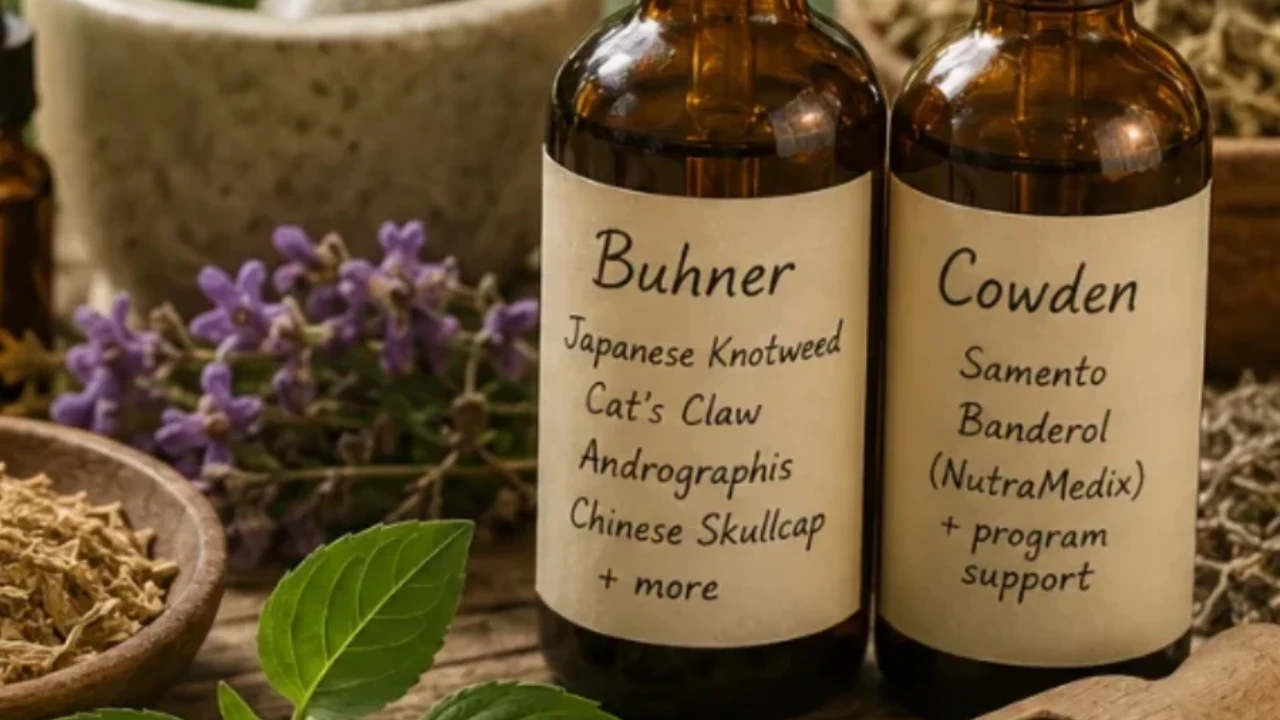
Herbal protocols (Buhner, Cowden, etc.)
Can help — with supervisionStructured herbal protocols are probably the most substantial natural approach in Lyme. Some herbs used in them show real antimicrobial activity against Borrelia in lab studies, and many people credit them with meaningful progress. For some — especially milder or earlier cases, or as ongoing support — they can be a genuine part of recovery.
Where I'd pump the brakes: they're often slow, they require consistency and quality products, and for deep, longstanding infections they frequently aren't enough on their own. Treat them as a serious tool within a plan, guided by someone who knows herbal dosing — not a DIY project from a forum. Want the detail? I break down the two best-known systems — herb by herb — in Buhner vs. Cowden protocol for Lyme.
Cryptolepis, Japanese knotweed & specific herbs
Cryptolepis, knotweed, cat's claw, Chinese skullcap
Promising, not proven aloneThese are the named herbs people search for most. Cryptolepis in particular has shown notable activity against Borrelia in laboratory research, and Japanese knotweed (resveratrol) is prized for both antimicrobial and anti-inflammatory support. Cat's claw and Chinese skullcap show up across many protocols.
Honest caveat: activity in a lab dish is not the same as clearing infection in a human body, where dose, absorption, biofilms, and quality all intervene. These can absolutely have a place — but as supervised parts of a broader approach, not magic bullets. Quality and interactions matter, so don't wing it.
Anti-inflammatory diet
Diet & nutrition
Genuinely worth doingThis is one I'll wholeheartedly endorse as support. An anti-inflammatory, whole-food diet — lower in sugar and processed food, rich in nutrients — won't kill Borrelia, but it can meaningfully lower the inflammation load your body is fighting, steady your energy, and help you tolerate treatment. It's low-risk, within your control, and it helped me feel more human on the hard days.
Just keep expectations honest: diet is a powerful foundation, not a cure for an active infection.
Supplements & immune support
Targeted supplements
Useful, when targetedCorrecting real deficiencies (think vitamin D, magnesium, omega-3s, and others identified by testing) and supporting the immune system can make a genuine difference in how you feel and function. The key word is targeted — guided by labs and a practitioner, not a cabinet full of random bottles from the internet.
Caution: "natural" doesn't mean "consequence-free." Supplements interact with medications and each other, and more is not better. This is support, not a stand-alone treatment.
Detox & drainage support
Detoxification & drainage
Important as supportWhen you're treating Lyme, your body has more to clear — and supporting your natural drainage pathways (hydration, gentle movement, sauna, binders where appropriate) can ease the "herx" reactions and help you tolerate treatment. I consider good detox support one of the more practically valuable pieces of the natural toolkit.
Reality check: detox helps you handle treatment; it doesn't replace the treatment doing the actual work.
Ozone & oxidative therapies
Ozone therapy & related oxidative treatments
Interesting — get it done rightOzone and related oxidative therapies are popular in integrative Lyme care, and some people report real benefit. They're more of a medical intervention than a home remedy, so the setting and provider matter enormously — this is not something to improvise. If you're drawn to it, it belongs in the hands of an experienced clinic, as one considered part of a plan.
Homeopathy
Homeopathy
Weak evidence as a primary treatmentI'll be straight because I care more about your recovery than about being popular: there's little solid scientific evidence that homeopathy eliminates a Borrelia infection. It's generally low-risk and some people feel it soothes symptoms, so I won't tell you it's worthless to you — but leaning on it as your main treatment for an active infection is exactly the kind of delay that can cost you dearly.
My honest take: at most a gentle complementary comfort measure — never the load-bearing wall of your plan.
Nervous-system & stress work
Nervous-system regulation, sleep, stress
Underrated and realThis gets dismissed as "soft," but a dysregulated, exhausted nervous system keeps the whole body stuck in fight-or-flight, which works against healing. Sleep, stress reduction, gentle pacing, and nervous-system work aren't a cure — but they create the conditions in which everything else works better. For me, this was more important than I ever expected.
How to use natural approaches wisely
Here's how I'd sum it all up for a friend:
- Use them as teammates, not substitutes. Support alongside real treatment: yes. Instead of it, while an infection persists: that's the trap.
- Get supervision. Herbs and supplements interact and vary wildly in quality — a Lyme-literate practitioner is worth it.
- Watch the clock. If you've been "trying natural" for months with no real progress, that's important information, not a reason to try harder at the same thing.
- Think whole-person. The people who recover usually combine the right medical treatment with diet, detox, immune, and nervous-system support — not one heroic remedy.
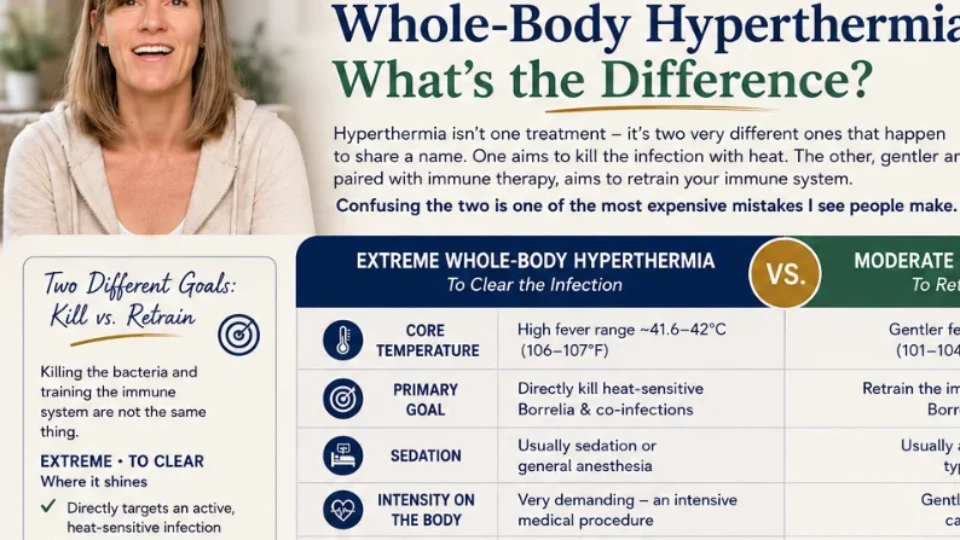
For where the deeper medical treatment comes in, see my guides to whole-body hyperthermia, Treg therapy, and when antibiotics stop working — or start with the big picture in treating late-stage & chronic Lyme.
If you're staring at a shelf of supplements wondering what's actually helping — or worried you're losing time — that's exactly the conversation I love to have. Let's sort out what's supporting you and what's just spinning your wheels.
Natural Treatment FAQ
Natural and holistic approaches can genuinely support recovery — calming inflammation, supporting immunity, easing symptoms, and helping you tolerate treatment. But relying on them alone to clear a longstanding infection is where many people lose valuable time. They work best within a comprehensive, supervised plan, not as a stand-alone cure. Results vary.
Commonly used: herbal antimicrobial protocols (Japanese knotweed, cat's claw, cryptolepis, Chinese skullcap), targeted supplements, an anti-inflammatory diet, detox support, and nervous-system regulation. Usefulness varies person to person — choose and dose them with a Lyme-literate practitioner rather than self-prescribing.
There's little robust evidence that homeopathy eliminates Borrelia. Some people feel it helps symptomatically and it's low-risk, but relying on it as a primary treatment for an active infection can delay more effective care. Best viewed as, at most, a complementary comfort measure.
Cryptolepis has shown antimicrobial activity against Borrelia in some lab studies and is used in several herbal protocols. Lab activity doesn't guarantee the same effect in the body, and quality, dosing, and interactions matter. It may have a place within a supervised herbal approach — not as a proven stand-alone cure.
For most people with chronic Lyme, natural approaches are best used alongside — not instead of — appropriate medical treatment. The risk of going natural-only is losing time while infection persists. A combined, individualized, supervised plan is usually wisest. Always consult a qualified professional before changing or stopping treatment.
References & further reading
- Centers for Disease Control and Prevention (CDC) — Lyme Disease. cdc.gov/lyme
- International Lyme and Associated Diseases Society (ILADS) — evidence-based guidelines and research. ilads.org
- MedlinePlus (U.S. National Library of Medicine, NIH) — Lyme Disease. medlineplus.gov
- Johns Hopkins Lyme Disease Research Center. hopkinslyme.org
Medical disclaimer: This article is for educational purposes only and reflects personal experience and general research. It is not medical advice, diagnosis, or treatment, and it does not replace consultation with a qualified healthcare professional who knows your individual history. Herbs, supplements, and therapies discussed here can carry risks, interact with medications, and are not appropriate for everyone; mention of any approach is not an endorsement. Christina Carter is a patient advocate and educator, not a licensed medical provider. Individual results vary. Always consult your physician before starting, stopping, or changing any treatment, supplement, or medication.