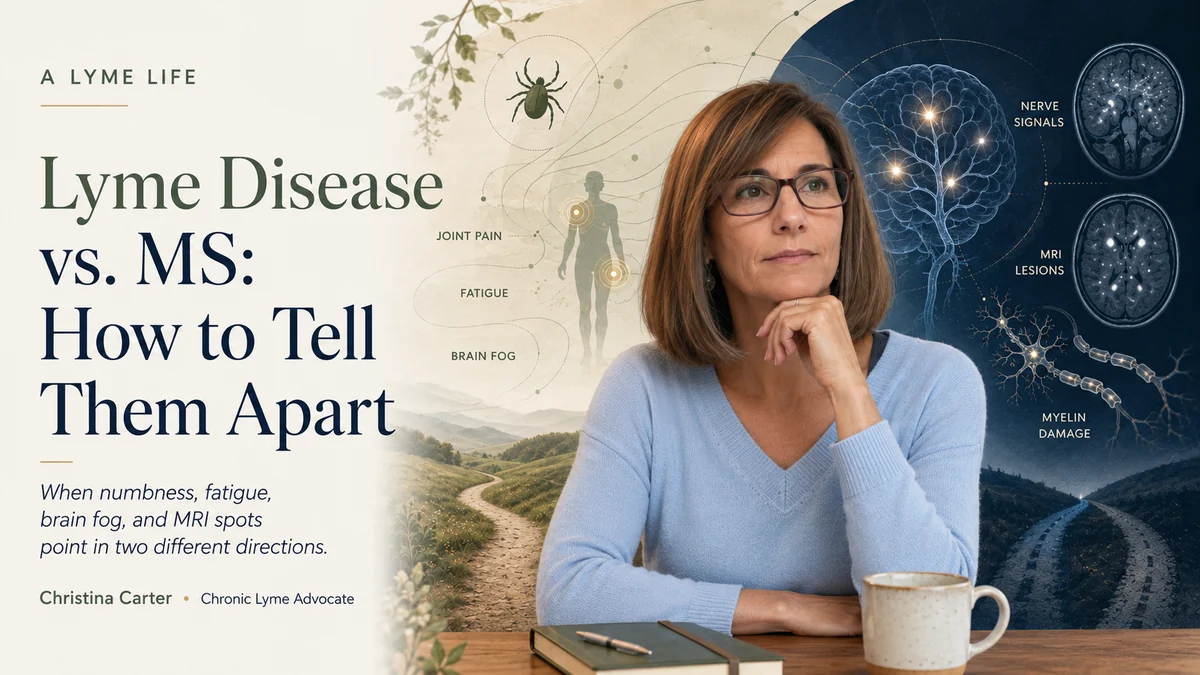
Lyme Disease vs. Long COVID: How to Tell Them Apart
The fatigue that flattens you, the fog that swallows your words, the crash after doing too little, the racing heart when you stand — chronic Lyme and Long COVID can be almost impossible to tell apart from the inside. Here's how the two genuinely overlap, where they diverge, why timing and testing matter so much, and why you don't want to miss the one that's actually treatable.
Something shifted when Long COVID entered the world. Suddenly millions of people understood, firsthand, what it means to be wrecked by an invisible illness — the bone-deep fatigue, the fog, the crash after a single good hour. For those of us in the Lyme world, it was a strange kind of recognition: this is what we've been trying to describe for years.
But that recognition cuts both ways. Because the two illnesses look so alike, a lot of people who developed lingering symptoms after a virus were told "Long COVID" and sent home — when what was actually driving their illness was a tick-borne infection that had been there all along, or one that surfaced in the chaos. And some people carrying a Lyme label really are dealing with a post-viral process. Untangling which is which is one of the most important questions you can ask, because one of these is a treatable infection.
Quick answer
What's the difference between Lyme disease and Long COVID?
Lyme disease is a bacterial infection carried by ticks. Long COVID is a post-viral illness that follows a SARS-CoV-2 infection. Their chronic symptoms overlap almost completely — fatigue, brain fog, post-exertional crashes, POTS and autonomic problems, unrefreshing sleep, and pain — so symptoms alone can't separate them. The clues that point to Lyme are timing (symptoms that began before COVID or after time outdoors), a history of tick exposure or a rash, migrating joint pain, and co-infections. The biggest practical difference: Lyme can be treated with antibiotics and antimicrobials, while Long COVID is managed supportively — so a missed Lyme diagnosis means a missed treatable cause. This is not medical advice.
Key Takeaways
- Different causes. Lyme is a tick-borne bacterial infection; Long COVID is a post-viral illness after SARS-CoV-2.
- The symptom overlap is enormous — fatigue, fog, POTS, post-exertional crashes, unrefreshing sleep, and pain appear in both.
- Timing is the biggest clue. Symptoms that predate COVID, or follow a tick bite or rash, point toward Lyme.
- Lyme brings multisystem tells — migrating joint pain, tick exposure, a rash, and co-infections — that aren't typical of Long COVID.
- The stakes are lopsided. Lyme is treatable; Long COVID has no specific cure yet — so missing Lyme is the costlier mistake.
- You can have both, and COVID may even stir up a dormant infection — so a muddy picture deserves a careful, open look.
Why the two get confused
Chronic Lyme and Long COVID are both what you might call "invisible, multisystem, post-infectious" illnesses — conditions where an infection sets off a cascade that lingers long after the initial trigger, affecting energy, the brain, the nervous system, and more. When you strip away the cause, what's left is a remarkably similar experience: a body that no longer refills its tank, a brain that stalls, and a crash waiting on the other side of any exertion.
There's also a timing coincidence that muddied everything. Long COVID exploded into public awareness in exactly the years when more people than ever were also spending time outdoors and tick ranges were expanding. So a wave of people arrived at clinics with fatigue, fog, and dysautonomia — and "Long COVID" became the ready explanation, sometimes without anyone asking about ticks. Lyme has always been the great imitator; it simply found a powerful new disease to imitate.
The result is honest diagnostic difficulty. No symptom, and no single test, cleanly separates the two. What separates them is the story around the symptoms — and that's what the rest of this guide is about.
Where the symptoms overlap
This is the part that makes people feel unmoored, so let's say it plainly. Both chronic Lyme and Long COVID can cause:
- Profound fatigue that rest doesn't repair
- Cognitive "brain fog" — slowed thinking, word-finding trouble, memory lapses
- Post-exertional malaise — a delayed crash after physical or mental effort
- POTS and dysautonomia — racing heart on standing, dizziness, temperature swings
- Unrefreshing sleep and being "tired but wired"
- Widespread pain, headaches, and exercise intolerance
- Mood changes — anxiety and depression layered on top of it all
That last cluster — POTS, post-exertional malaise, and dysautonomia — is especially telling, because it shows both conditions can dysregulate the autonomic nervous system, the part that runs your heart rate, blood pressure, and energy. When two illnesses hit the same control system, they produce the same downstream chaos. This is exactly why "it feels like being poisoned by exertion" describes both.
Where they actually differ
Even though the chronic phase looks alike, the two illnesses have different origins and different company. The most useful question is: what surrounds the symptoms — a virus, or a tick?
Long COVID, by definition, follows a SARS-CoV-2 infection. It's a post-viral syndrome, and its story almost always starts with "I got COVID and never fully recovered." Lyme, by contrast, is a bacterial infection from a tick, and it's multisystem in a way that leaves fingerprints Long COVID doesn't — a rash, migrating joint pain, and co-infections that ride along with it.
| Chronic Lyme | Long COVID | |
|---|---|---|
| Underlying cause | Bacterial infection (Borrelia) from a tick bite | Post-viral illness after SARS-CoV-2 (COVID) |
| Typical onset | Any time; often after outdoor exposure or a bite | Dates from a confirmed or likely COVID infection |
| Tell-tale early signs | Tick exposure, an expanding rash, flu-like onset | Symptoms that persist or return weeks after COVID |
| Joint pain | Common; often migrates from joint to joint | Can occur, but not migratory in the Lyme pattern |
| Co-infections | Common (Babesia, Bartonella) and shift the picture | Not a feature |
| Loss of taste/smell | Not characteristic | Classic in COVID; can persist in Long COVID |
| Response to antimicrobials | Symptoms often improve once treated | No response — it isn't an active bacterial infection |
So while the fatigue and fog look identical, the surrounding evidence is where they part ways. A summer spent outdoors, a bullseye rash you remember, joint pain that hops from knee to knee, a partner or child who also got sick, air hunger that smells like a co-infection — these belong to Lyme's world, not Long COVID's. And a clear "it all started with COVID and I have the positive test to prove it," with loss of taste and smell in the acute phase, leans the other way.
Timing: the most important clue
If you take one practical tool from this article, make it this one. When did your symptoms actually begin?
Clinicians who work at this crossroads keep coming back to timing, because it's the cleanest signal you have. If your fatigue, fog, and crashes clearly started after a COVID infection and not before, Long COVID moves up the list. But if you can trace symptoms to before you ever had COVID — or to a summer outdoors, a tick bite, or a rash — then a tick-borne infection deserves a serious look, no matter what label you were given later.
This is also why a symptom timeline is worth building before your next appointment. A simple written history — when each symptom started, any tick exposure or rash, when you had COVID, what's improved and what hasn't — gives a clinician the single most useful thing for telling these two apart. It turns a vague "I've felt awful for a while" into a story someone can actually reason about.
Testing & how a diagnosis is made
Neither illness has one perfect test, which is exactly why they get muddled — but the diagnostic paths still differ.
Long COVID is, in practice, a clinical diagnosis: a documented or likely COVID infection followed by symptoms that persist, usually for at least several months, without a better explanation. There's no confirmatory blood test — it's diagnosed by the story and by ruling other things out. And that phrase, ruling other things out, is the door Lyme should walk through.
Lyme has actual testing, though it's imperfect. Standard two-tier serology looks for antibodies, but it misses a meaningful share of cases — a negative test doesn't rule Lyme out, especially in later or partially treated illness. That's why exposure history and the clinical picture carry so much weight, and why some clinicians use specialty labs like ArminLabs or IGeneX when the standard test is unrevealing but the story fits.
If you've been handed "Long COVID" but no one has genuinely evaluated you for tick-borne infection, that's a gap worth closing. People are misdiagnosed for years precisely because a plausible label ended the search too early.
Why getting it right matters so much
Here's the heart of it, and the reason this is worth pushing on even when you're exhausted. One of these conditions is treatable, and one currently isn't.
Lyme is a bacterial infection. It responds to antibiotics and antimicrobials, and when Lyme is the cause, treating it can meaningfully improve — sometimes transform — the fatigue, fog, and pain, because you're removing the driver. Long COVID, for now, has no specific cure; it's managed by supporting the body, pacing, and easing symptoms while research races to catch up.
So the asymmetry is stark. If you actually have Long COVID and it's called Lyme, you'll try treatments that don't help. But if you actually have Lyme and it's called Long COVID, you may spend years managing symptoms of an infection that could have been treated at the source. That second mistake is the expensive one, and it's the one this whole article is meant to help you avoid.
To be fair and clear: this is not a claim that Long COVID is "really just Lyme," or that everyone with post-COVID symptoms should chase a tick-borne diagnosis. Long COVID is real and deserves to be taken seriously in its own right. The point is narrower — when the picture is genuinely unclear, the treatable possibility deserves to be ruled in or out, not assumed away.
Can you have both?
Yes — and this is where it gets genuinely complex. You can carry a tick-borne infection and develop Long COVID, and the two can pile onto each other, leaving you sicker than either would alone. Many people in the chronic-illness world are living in exactly that overlap.
There's also a growing question that researchers are actively chasing: whether a COVID infection can reactivate or worsen a dormant infection like Lyme or Epstein-Barr, tipping a person who was coping into a full relapse. If that's part of your story — stable for years, then a COVID infection, then a crash — it doesn't mean you have to choose one label. It means the honest answer is "both processes may be in play," and the goal becomes careful evaluation rather than forcing everything under a single tidy name.
What to ask your clinician
You don't need to argue with anyone. You need a few precise questions that keep the door open to the treatable answer. Bring these to whoever is managing your care:
- "My symptoms started before / around / after my COVID infection — how does that change what we're considering?" Put the timeline on the table.
- "Have we actually tested me for Lyme and common co-infections, or was it assumed to be Long COVID?"
- "Given my tick exposure / rash / migrating joint pain, how have we ruled Lyme in or out?"
- "Since Long COVID is diagnosed by exclusion, what treatable causes have we actually excluded?"
- "If standard Lyme testing is negative but my history fits, what's our next step?"
- "If I don't fit neatly into either box, can we treat this as possibly both rather than picking one?"
If your tick exposure keeps getting waved off, or "Long COVID" is being used to close the file rather than open a work-up, that's a signal to slow the process down — not to give up. Start with the full Lyme symptom picture and, if you keep hitting walls, how to get a doctor to take chronic Lyme seriously.
And if you're staring at a Long COVID label that doesn't fully fit — or you just want someone who has lived this exact fog and fatigue to help you think it through — you don't have to sort it out alone. I've walked this crossroads with people, and with my own family, and I can help you find your next clear step.
Lyme vs. Long COVID FAQ
Yes, and it happens often. Chronic Lyme and Long COVID share almost the same symptom picture — deep fatigue, brain fog, post-exertional crashes, POTS and other autonomic problems, unrefreshing sleep, and widespread pain. Since Long COVID became common, many people with lingering symptoms after a viral illness were labeled Long COVID without ever being evaluated for a tick-borne infection, and the reverse also happens. Because Lyme is a treatable infection and Long COVID currently is not, being tested for Lyme matters — especially if your symptoms started before COVID or aren't improving. Not medical advice.
Lyme disease is a bacterial infection spread by ticks. Long COVID is a post-viral illness that follows a SARS-CoV-2 infection. Their chronic symptoms overlap heavily, but the clues differ: Lyme often comes with tick exposure, a rash, migrating joint pain, and co-infections, and it can begin at any time; Long COVID by definition begins after a confirmed or likely COVID infection. The biggest practical difference is that Lyme can be treated with antibiotics, while Long COVID is managed supportively — so missing a Lyme diagnosis means missing a treatable cause. Not medical advice.
Timing is the single most useful clue: if your symptoms clearly began after a COVID infection and not before, Long COVID is more likely; if they started before COVID, after time outdoors, or after a tick bite or rash, Lyme deserves a close look. Beyond timing, Lyme tends to bring multisystem signs that aren't typical of Long COVID — migrating joint pain, tick exposure or an expanding rash, and co-infections. Symptoms alone can't separate them; it takes history, exposure, and testing, and sometimes the two coexist. Not medical advice.
Because one of them is a treatable infection. Lyme disease is caused by bacteria that respond to antibiotic and antimicrobial treatment, and addressing it can meaningfully improve symptoms. Long COVID has no specific cure yet and is managed by supporting the body and easing symptoms. If a treatable tick-borne infection is driving your illness but everything gets filed under Long COVID, you lose the chance to treat the actual cause — which is why it's worth making sure Lyme has genuinely been ruled in or out. Not medical advice.
Yes. You can have a tick-borne infection and also develop Long COVID, and the two can compound each other. There is also growing interest in whether a COVID infection can reactivate or worsen a dormant infection like Lyme, leaving people sicker than either would alone. If your picture is complicated, the goal isn't to force everything under one label — it's careful evaluation that takes both a post-viral process and a possible active infection seriously. Not medical advice.
References & further reading
- Centers for Disease Control and Prevention (CDC) — Lyme Disease. cdc.gov/lyme
- Centers for Disease Control and Prevention (CDC) — Long COVID / Post-COVID Conditions. cdc.gov
- Johns Hopkins Lyme Disease Research Center — long-haul Lyme and long-haul COVID. hopkinslyme.org
- International Lyme and Associated Diseases Society (ILADS). ilads.org
- MedlinePlus (U.S. National Library of Medicine, NIH) — Lyme Disease. medlineplus.gov
Medical disclaimer: This article is for educational purposes only and reflects personal experience and general information. It is not medical advice, diagnosis, or treatment, and it does not replace consultation with a qualified healthcare professional. Both Long COVID and Lyme disease are serious conditions that require proper medical evaluation; distinguishing them can be difficult even for specialists. Do not start, stop, or change any treatment based on this article. Christina Carter is a patient advocate and educator, not a licensed medical provider. Individual results vary. Always consult a qualified clinician.