Lyme Disease Rash: Bullseye & Beyond
Everyone's told to watch for the "bull's-eye." But the truth is messier: the classic target rash is only one version, many Lyme rashes look nothing like it, and most people with Lyme never see a rash at all. Here's what it really looks like — and why its absence proves nothing.
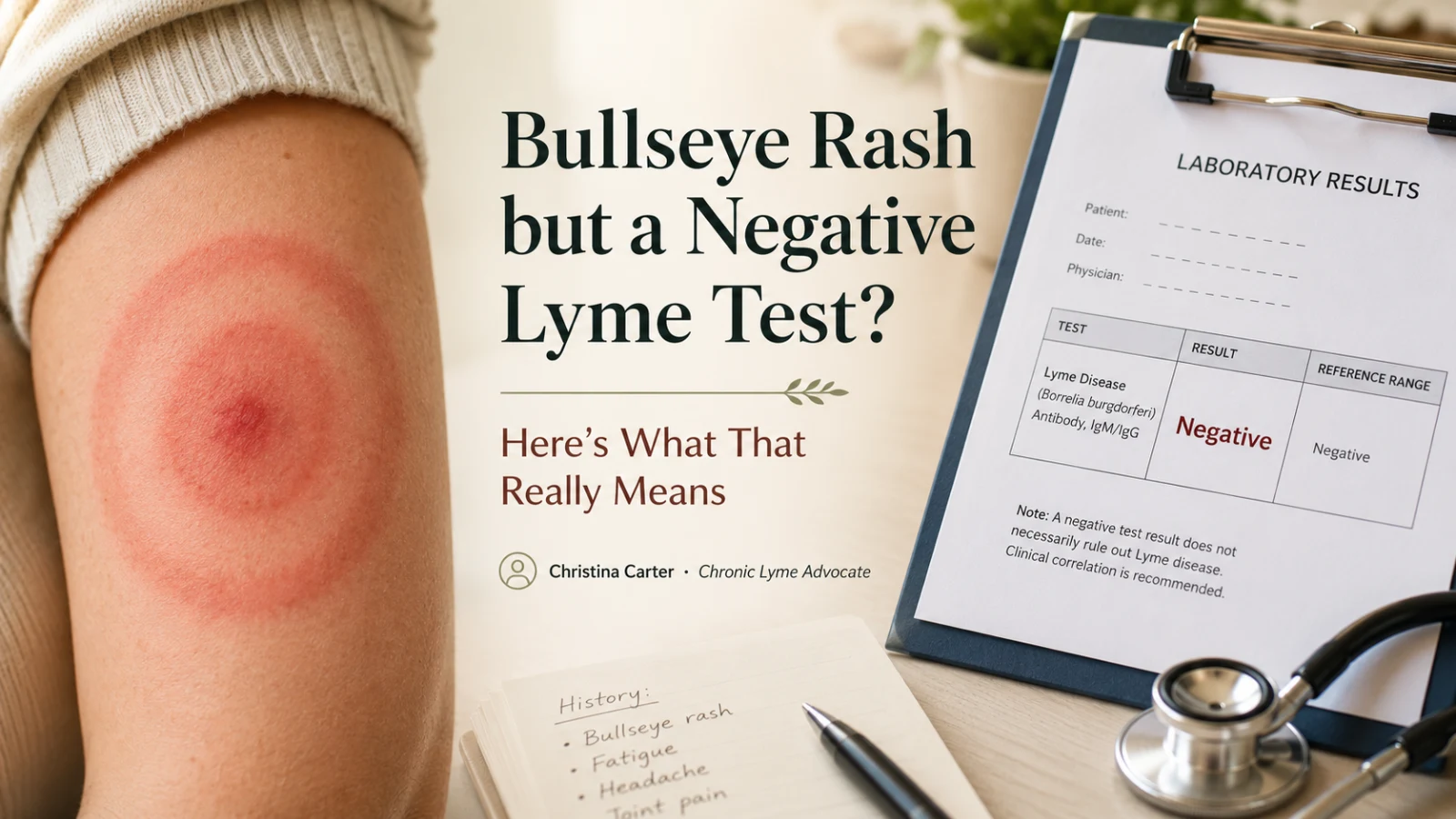
If there's one image burned into everyone's mind about Lyme, it's the bull's-eye rash — a neat red ring with a clear center, like a target drawn on the skin. It's the picture on every warning poster. And it's genuinely useful when it shows up, because a true bull's-eye is one of the few signs that lets a doctor diagnose Lyme on sight.
But here's what almost nobody tells you: that tidy target is the exception, not the rule. The medical name for the Lyme rash is erythema migrans — literally "migrating redness" — and it comes in far more shapes than the poster suggests. Understanding the whole range, and its limits, matters more than memorizing one picture.
Quick answer
What does a Lyme disease rash look like?
The classic Lyme rash, called erythema migrans, is an expanding red area that can develop a clearing center, giving it a target or bull's-eye appearance. But many Lyme rashes are not classic at all — they can be a solid, evenly red oval, bluish or purplish, crusted, or blister-like, and they may appear anywhere on the body. The rash is usually not itchy or painful and expands over days.
Key Takeaways
- The classic bullseye is only one version of the Lyme rash.
- Many Lyme rashes look nothing like a target — solid, oval, or irregular.
- Most people with Lyme never get a rash at all — its absence proves nothing.
- It differs from a bug bite — it tends to expand over days and isn’t very itchy.
- If you spot one, act — a true erythema migrans is enough to treat without waiting on a test.
The classic bull's-eye (erythema migrans)
The textbook rash is a red patch that expands outward over days, often developing a clearing in the middle so it reads as concentric rings — a red bull's-eye. It's typically flat, can grow quite large (much bigger than an ordinary bite reaction), and usually isn't itchy or painful. When it appears near the site of a known tick bite and keeps expanding, it's about as close to a "smoking gun" as Lyme offers.
If you see this, don't wait. A true erythema migrans rash is reason enough for a clinician to act on Lyme without waiting for blood tests — which, as I explain in my guide to Lyme testing, can miss the infection entirely in the early days.
- Classic bull's-eye: red ring with a clearing center — the version everyone's taught to spot.
- Solid & uniform: an evenly red, expanding oval with no ring at all — very common.
- Atypical: bluish-purple, crusted, or blistered — easily mistaken for something else.
The rashes that don't fit the picture
This is where people get misled. A great many Lyme rashes are not classic targets. They can be:
- A solid, evenly red oval — no ring at all
- Bluish or purplish in tone
- Crusted or scabbed in the center
- Blister-like or with a raised center
- Faint and easy to overlook
- Multiple rashes at once (a sign it may have spread)
- On darker skin, harder to see and often missed entirely
On deeper skin tones, redness reads differently and the rash frequently goes unrecognized — a real and under-discussed reason Lyme gets missed. If you have a spreading patch that behaves like erythema migrans, take it seriously regardless of whether it forms a perfect ring.
Waiting for a bull's-eye is one of the most costly mistakes in Lyme. The rash you're actually likely to get may not look like the poster — and you may get no rash at all.
When it appears & how long it lasts
An erythema migrans rash usually shows up within days to about a month after a bite — often around a week or two — and grows gradually rather than appearing full-size overnight. Left alone it may persist for a few weeks before fading. But timing varies a lot from person to person, and a rash that fades does not mean the infection is gone. The bacteria can spread while the skin clears.
Because it can be short-lived, tucked out of sight, or never form at all, you can't use "no rash now" as evidence of anything. If you had possible exposure, keep watching your whole body — including the scalp, hairline, behind the ears, waistband, and skin folds where a poppy-seed-sized nymph tick hides.
What it feels like — and how it differs from a bug bite
An ordinary insect bite reaction is usually small, itchy, and fades within a day or two. A Lyme rash is different: it tends to be larger, expanding over days, and often neither itchy nor painful, though some people notice mild warmth, itch, or tenderness. The key tell isn't how it feels — it's that it keeps growing. A small itchy bump that shrinks is likely just a bite. A patch that spreads outward day by day deserves urgent attention.
Why most people never see a rash
Here's the part that shaped my whole view of this illness: a large share of people with Lyme never develop or never notice a rash. Some never get one. Others get one in a spot they simply can't see. Many mistake it for a spider bite, ringworm, or an allergic reaction and never connect it to a tick.
This is why so many of us — myself included — go years misdiagnosed. When there's no rash and no remembered bite, the classic warning system fails, and the infection quietly settles in. If your gut says something is wrong even without a rash, please don't let its absence close the door. Learn the broader picture in my overview of the stages of Lyme and the unusual symptoms that get overlooked.
What to do if you spot one
- Photograph it right away, with a date and something for scale (a coin works). Take pictures over the next few days so the expansion is documented.
- See a clinician promptly. A true erythema migrans rash is grounds to treat early — do not wait for it to fade or for a "confirming" test.
- Note the timeline — when you were outdoors, any bite you remember, and when the rash appeared and how it changed.
- Check the rest of your body and household, especially children, in hidden spots. See what to do after a tick bite.
- Don't rely on a negative test in the early window — antibodies take time to develop. The rash can be more telling than the bloodwork at this stage.
If you've had a rash, a bite, or symptoms and no one is taking it seriously, that's exactly the moment I want you to reach out. I've lived the years-long misdiagnosis, and I help people act early instead of losing time. Let's talk.
Lyme Rash FAQ
The classic rash, erythema migrans, is an expanding red area that can develop a clearing center, giving a target or bull's-eye look. But many Lyme rashes aren't classic — they can be a solid red oval, bluish or purplish, crusted, or blister-like, and appear anywhere on the body. It's usually not itchy or painful and expands over days.
It typically appears within days to about a month after a bite and expands gradually. Left alone it may persist for a few weeks before fading, though timing varies. Because it comes and goes and can be missed entirely, its absence never rules Lyme out.
No. A large share of people with Lyme never develop or never notice a rash. Rashes on the scalp or in skin folds are easily missed, and many bites never produce the classic bull's-eye. Waiting for a rash — or ruling out Lyme because there wasn't one — is a mistake.
Usually not. Unlike an ordinary bite reaction, the classic Lyme rash is often neither itchy nor painful, though some people report mild warmth, itch, or tenderness. What sets it apart is that it expands outward over days rather than staying small like a typical bug bite.
References & further reading
- Centers for Disease Control and Prevention (CDC) — Lyme Disease. cdc.gov/lyme
- International Lyme and Associated Diseases Society (ILADS) — evidence-based guidelines and research. ilads.org
- Johns Hopkins Lyme Disease Research Center. hopkinslyme.org
- LymeDisease.org — patient advocacy and education. lymedisease.org
Medical disclaimer: This article is for educational purposes only and reflects personal experience and general information. It is not medical advice, diagnosis, or treatment, and it does not replace consultation with a qualified healthcare professional. A rash cannot be diagnosed from a description or photo; any new or spreading rash should be evaluated in person by a clinician. Christina Carter is a patient advocate and educator, not a licensed medical provider. Individual results vary. Always consult a qualified clinician.