Lyme Disease Symptoms in Kids & Children: The Signs Parents Miss
In children, Lyme rarely announces itself with a tidy bull's-eye rash. It shows up as the child who's suddenly exhausted, achy, anxious, or "not themselves" — and it gets blamed on growing pains, screen time, or a rough patch at school. I've lived this as a mother twice over. Here is what I wish every parent knew to look for.
I have watched Lyme move through my own child not once, but twice. My daughter was treated for Lyme in Germany in 2017, when she was fourteen. She got her life back — and then, years later, a tick bite in college brought it all roaring back. After two years of carefully preparing her body and her spirit, she is now, at twenty-three, going through treatment at Lyme Re-code. So when I tell you I know how frightening it is to watch this happen to your child, I mean it in the most literal way a mother can.
Quick answer
What are the symptoms of Lyme disease in children?
Children with Lyme can have the same physical symptoms adults do — fatigue, joint and muscle pain, headaches, and flu-like feelings — but in kids the illness very often shows up as changes in behavior, mood, focus, sleep, and school performance. A previously easygoing child may become irritable, anxious, or withdrawn; a strong student may suddenly struggle to concentrate. Because young children can't always describe what they feel, these behavioral and emotional shifts are frequently the first and loudest sign.
Key Takeaways
- In kids, Lyme rarely shows a tidy bullseye — it looks like sudden exhaustion, aches, anxiety, or “not themselves.”
- It gets blamed on growing pains, screens, or school stress, so it’s easy to miss.
- Watch behavioral and emotional signs, not just physical ones.
- I’ve walked pediatric Lyme twice with my own daughter — treated at 14, then reinfected years later.
- Advocate hard for your child — you know when something’s wrong.
Why Lyme is so easy to miss in children
The hardest thing about Lyme in kids is that a child often can't tell you what's wrong. A grown adult can say "my joints ache and my brain feels foggy." A seven-year-old just gets clingy, or melts down, or stops wanting to do the things they loved. The illness is speaking — we just have to learn its language.
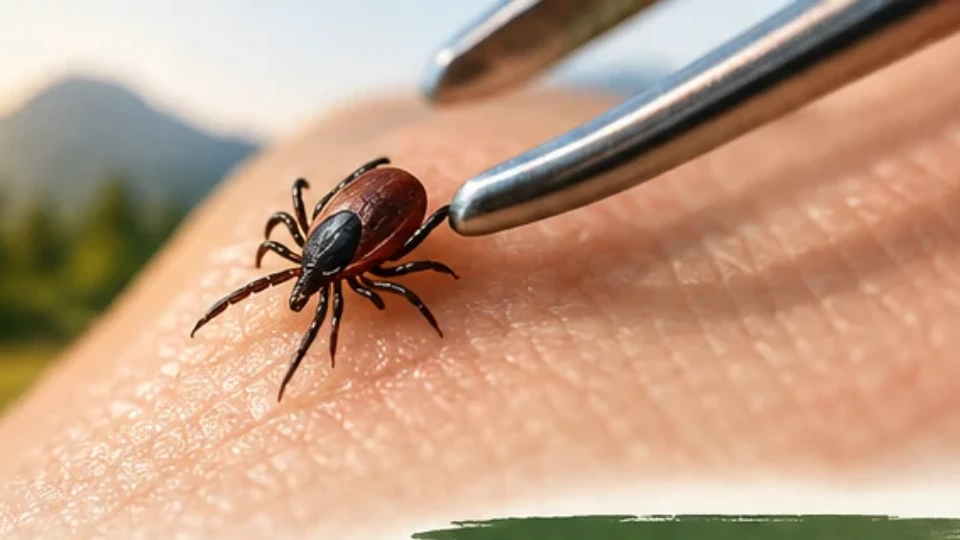
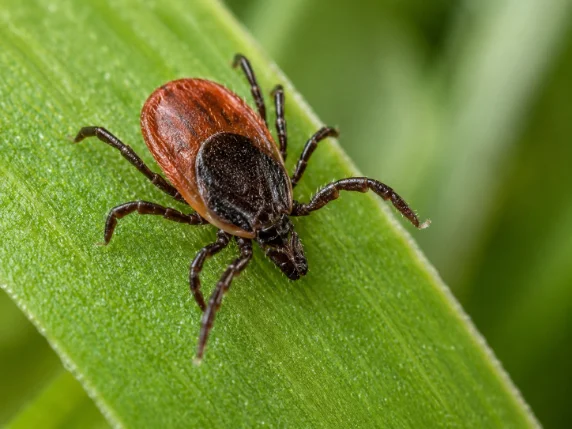
On top of that, most children with Lyme never have the classic bull's-eye rash, and many never had a remembered tick bite at all. Ticks in the nymph stage are the size of a poppy seed and love the scalp, behind the ears, the hairline — exactly where a parent won't spot them. So the tidy story we're taught to look for — bite, rash, diagnosis — frequently never happens. What's left is a slow, confusing drift that's far too easy to explain away.
The physical symptoms in kids
These are the bodily symptoms children and teens most commonly show:
- Unexplained, out-of-character fatigue
- Migrating joint pain — often blamed on "growing pains"
- Headaches, sometimes frequent or severe
- Stomachaches and appetite changes
- Flu-like feelings that come and go
- Fevers, swollen glands
- Dizziness & heart palpitations
- Sensitivity to light, sound, or touch
- Sleep problems — trouble falling asleep, night waking
- Tingling, numbness, or odd nerve sensations
Notice how many of these are the ones a busy pediatric visit tends to file under "kids get aches" or "it's a virus." Individually, any one of them is unremarkable. It's the cluster, and the fact that it doesn't resolve, that should raise a flag.
The behavioral & emotional signs parents miss
This is the part I care about most, because it's where children get failed. Tick-borne infections can affect the nervous system and the brain, and in kids that often shows up first as changes in behavior, mood, and focus — not as a physical complaint at all.
Before I did this work, I spent years as a children's psychiatric caseworker for the state of Nevada, and I began my career in a children's residential psychiatric hospital. I have sat with a great many children whose "behavioral problems" had a physical driver underneath that nobody was looking for. That background is exactly why I refuse to accept a purely behavioral label at face value when a child changes suddenly. In children with Lyme and related infections, families frequently describe:
- New or worsening anxiety or depression
- Sudden irritability, rage, or meltdowns
- OCD-like behaviors, rituals, or intrusive fears
- Tics or repetitive movements
- Trouble focusing; a drop in school performance
- Brain fog, memory & word-finding trouble
- Withdrawal from friends and activities
- Regression to younger behaviors
- Emotional swings that seem to come from nowhere
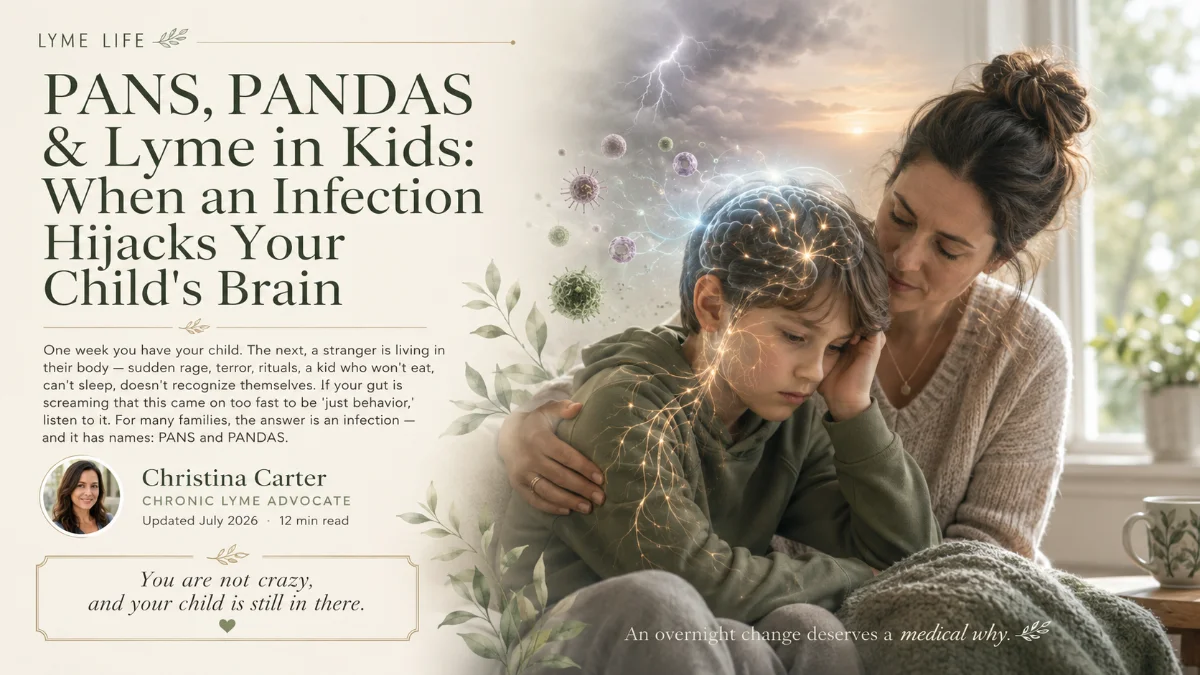
When these appear suddenly, especially after an illness or possible exposure, it overlaps with what clinicians call PANS and PANDAS. I want to say this as clearly as I can: these changes are real and physiological. They are not a discipline problem, a parenting failure, or a child "acting out." A child in this state is not giving you a hard time — they are having a hard time.
The tragedy of pediatric Lyme is how often a sick child gets a behavioral label and a behavioral plan, while the infection driving it all goes unnamed for years.
How it looks at different ages
Toddlers and younger children often can't localize or describe symptoms, so it comes out sideways — clinginess, meltdowns, regression, sleep disruption, refusing activities they used to love, vague "my tummy hurts" or "my legs hurt." Watch behavior and energy, not just words.
School-age kids may show a slipping grades, a child who "can't focus anymore," headaches and stomachaches on school mornings, joint pain dismissed as growing pains, and mood changes that get read as attitude.
Teens and college students can describe more, but their symptoms are easily written off as stress, hormones, anxiety, or "typical teenager." That's precisely what happened in our family — twice. A tick bite in college is easy to shrug off, and the fatigue and fog that follow blend right into a demanding semester until they don't.
What I learned watching my daughter go through it twice
In 2017, at fourteen, my daughter was treated in Germany. I learned then how much further some clinics abroad were willing to go to actually resolve the infection rather than just manage it. She recovered, grew up, went to college — and a tick bite there set the whole thing in motion again.
The second time, I did things differently. We spent two years preparing her body and her spirit before beginning treatment — supporting her system, reducing her load, and getting her ready emotionally for what serious treatment asks of a person. At twenty-three she is going through treatment now at Lyme Re-code. If there's one thing I'd pass to another parent, it's that readiness matters. Rushing a depleted, frightened child into aggressive treatment is not the same as preparing them for it.
The other lesson: a negative test or a past recovery does not mean it can't be Lyme, or can't be Lyme again. Reinfection is real. Trust the pattern in front of you.
Treatment for children — and what I've seen
I'm not here to prescribe anything — that's for a qualified clinician, and pediatric treatment must be tailored to the child. What I can offer is that I've walked this road alongside families. I've accompanied several parents as their children received whole-body hyperthermia treatment, and I know how much it helps to have someone beside you who has been in that waiting room, who knows the questions to ask and the fears that come at 3 a.m.
Every child is different. The right path depends on the child's age, symptoms, other infections, and overall resilience, and it should always be guided by an experienced medical team. My role is to help families understand their options, find clinicians who take children's symptoms seriously, and feel less alone in the process.
This road can start very early — sometimes at birth, with congenital Lyme, Lyme passed on during pregnancy. I've documented our own family's journey treating a child's Lyme with the Wiegman Protocol — not as a recipe to copy, but so another parent can see that a diagnosis is a starting point, not the end of the story.
How to advocate for your child
- Write it all down — every symptom, when it started, and how it's changed. A clear timeline is your most powerful tool and is much harder to dismiss.
- Note any outdoor or tick exposure, even months back, even without a remembered bite or rash.
- Take behavioral and mood changes seriously as physical symptoms — don't let them be split off from the medical picture.
- Learn the limits of testing so a negative result doesn't end your search — see my guide to Lyme testing.
- Find a clinician experienced with tick-borne illness in children who will listen to you and to your child.
- Trust what you see. No one knows your child the way you do. If you know something is wrong, keep going until someone takes it seriously.
If you're watching your child slip away from themselves and no one will listen, you are exactly who I do this for. I've been that mother. Let's talk.
Kids & Lyme FAQ
Children can have the same physical symptoms adults do — fatigue, joint and muscle pain, headaches, flu-like feelings — but in kids Lyme very often shows up as changes in behavior, mood, focus, sleep, and school performance. Because young children can't always describe what they feel, these emotional and behavioral shifts are frequently the first and loudest sign.
Yes. Tick-borne infections can affect the nervous system, and many families report new or worsening anxiety, mood swings, rage, OCD-like behaviors, tics, and attention problems — sometimes appearing suddenly. This overlaps with PANS and PANDAS. These changes are real and physiological, not a discipline or parenting problem, and deserve evaluation by a clinician experienced with tick-borne illness.
Early signs can include a rash, fever, fatigue, headache, aches, and swollen glands after possible tick exposure — but many children never have a remembered bite or a classic rash. Watch for unexplained tiredness, new joint pain, headaches, and sudden changes in mood, focus, or behavior in the weeks after outdoor exposure. Not every child has an obvious onset, which is part of why Lyme is missed.
Write down your child's symptoms and when they started, note any outdoor or tick exposure even without a remembered bite, learn the real limits of Lyme testing so a negative result doesn't end your search, and find a clinician experienced with tick-borne illness in children. Trust what you see in your own child. Diagnosis and treatment must be guided by a qualified medical professional.
In toddlers, Lyme often shows up as changes a young child can't put into words: new clinginess, meltdowns, regression, disrupted sleep, refusing activities they used to enjoy, and vague "my tummy hurts" or "my legs hurt." Because toddlers can't describe symptoms, parents usually notice a shift in behavior, mood, and energy before any physical sign. Any sudden, unexplained change after possible tick exposure is worth raising with a clinician experienced in tick-borne illness.
Lyme in children is diagnosed clinically — from symptoms, history, and possible tick exposure — supported by blood testing. Standard Lyme tests can miss early or long-standing infection, so a negative result doesn't rule it out, especially when a child had no remembered bite or rash. Diagnosis should be guided by a clinician experienced with tick-borne illness in children rather than a single test.
References & further reading
- Centers for Disease Control and Prevention (CDC) — Lyme Disease. cdc.gov/lyme
- International Lyme and Associated Diseases Society (ILADS) — evidence-based guidelines and research. ilads.org
- Johns Hopkins Lyme Disease Research Center. hopkinslyme.org
Medical disclaimer: This article is for educational purposes only and reflects personal experience and general information. It is not medical advice, diagnosis, or treatment, and it does not replace consultation with a qualified pediatric healthcare professional. The symptoms described have many possible causes, most of them unrelated to Lyme, and require proper medical evaluation. Decisions about testing and treatment for a child must be made with a qualified clinician. Christina Carter is a patient advocate and educator, not a licensed medical provider. Individual results vary. Always consult a qualified clinician.