Can Lyme Disease Cause Heart Palpitations?
Your heart pounds, flutters, or takes off for no reason — and someone tells you it's just stress. Sometimes it is. But Lyme can genuinely reach the heart, in two very different ways, and one of them is a rare emergency worth knowing about. Here's how to tell them apart, and what to do.
One of the most frightening parts of our family's Lyme years wasn't the pain — it was the nights my heart would suddenly gallop while I was lying perfectly still. If you've felt that, you know the particular fear it brings. Your body is doing something you can't control, in the one organ you can't afford to lose, and the usual answer is a shrug and the word "anxiety."
So let me answer the question plainly: yes, Lyme disease can cause heart palpitations. But how it does matters enormously, because the two main routes are completely different — one is a rare medical emergency, and the other is common, miserable, and manageable. Knowing which is which is the whole point of this page.
Quick answer
Can Lyme disease cause heart palpitations?
Yes. Lyme can affect the heart in two very different ways. The first is Lyme carditis, where the Borrelia infection reaches heart tissue and disrupts its electrical signaling — an uncommon but potentially serious cause that can produce a pounding, slow, or irregular heartbeat. The second, and more common in chronic Lyme, is dysautonomia — dysregulation of the autonomic nervous system that controls heart rate, which can cause a racing or fluttering heart, often worse on standing. Palpitations always deserve medical evaluation, because they can also come from causes unrelated to Lyme. This is not medical advice.
Key Takeaways
- Yes, Lyme can cause palpitations — through two very different mechanisms.
- Lyme carditis is the uncommon, serious one: the infection disrupts the heart's electrical system and can cause heart block. It's usually reversible with prompt treatment — but it's an emergency while active.
- Dysautonomia and POTS are the more common cause in chronic Lyme — a racing or fluttering heart, often worse on standing.
- Co-infections like Bartonella and Babesia are strongly linked to a racing heart and air hunger.
- "It's just anxiety" is a trap — sometimes true, but too often a reason no one looks further.
- Red flags — fainting, chest pain, breathlessness, or a very slow/fast/irregular pulse — mean get help now.
Yes — but for two different reasons
When people ask whether Lyme can cause palpitations, they're usually picturing one thing: the infection somehow "attacking" the heart. That does happen — it's called Lyme carditis — but it's actually the rarer of the two explanations. The more common reason a chronic-Lyme heart misbehaves is that the nervous system controlling the heart has been thrown off, not the heart muscle itself.
Both are real. Both can make you feel your heartbeat when you normally wouldn't. But they sit at opposite ends of the urgency scale, so it helps to hold them apart from the start:
| Lyme carditis | Dysautonomia / POTS | |
|---|---|---|
| What's affected | The heart's own electrical wiring | The autonomic nerves that regulate heart rate |
| How common | Uncommon | Common in chronic Lyme |
| Typical feel | Slow, skipped, or pounding beats; lightheadedness; fainting | Racing or fluttering heart, often on standing |
| Urgency | Can be an emergency — needs prompt care | Distressing but usually not immediately dangerous |
| Outlook | Usually reverses with prompt treatment | Improves as infection and autonomic function are addressed |
Lyme carditis: when the infection reaches the heart
Lyme carditis is what happens when Borrelia bacteria make their way into heart tissue. Their favorite target is the heart's electrical system — the wiring that tells the upper and lower chambers when to beat together. When that signal is disrupted, you get heart block: the beat slows or stutters, and you can feel it as a pounding, skipping, or oddly slow pulse, sometimes with dizziness, breathlessness, or fainting.
Here's the balance I want to strike honestly. Lyme carditis is uncommon, and when it's caught, it usually resolves completely with prompt antibiotic treatment — hearts often go back to normal. But while it's active it can be dangerous, and in rare cases it has been fatal when no one recognized it. That's not said to frighten you; it's said because it's the one Lyme heart problem where speed genuinely matters. I wrote about this more fully in Can Lyme disease kill you? — carditis is the honest answer to that question.
The more common culprit: dysautonomia & POTS
For most people living with chronic Lyme, palpitations aren't carditis at all — they're a symptom of dysautonomia, dysfunction in the autonomic nervous system that runs your heart rate, blood pressure, and a hundred other automatic jobs. When that system is dysregulated, your heart can race, pound, or flutter without any problem in the heart muscle itself.
The classic form is POTS (postural orthostatic tachycardia syndrome): you stand up, and your heart rate leaps, the room tilts, and you feel like you might pass out. It's exhausting and genuinely disabling — and it's endlessly mislabeled as anxiety. I go deep on this in Lyme, POTS & dysautonomia, including why standing up becomes an ordeal and what actually helps. If your palpitations are tied to position, effort, heat, or standing, that's the direction worth exploring.
This route is also why palpitations so often travel with the rest of the chronic-Lyme picture — the fatigue, the brain fog, the neurological symptoms. They share a common thread: a nervous system under siege.
Bartonella, Babesia & the racing heart
Ticks rarely deliver just Lyme. The co-infections that ride along can be the real engine behind a racing heart:
- Babesia — a malaria-like parasite classically tied to air hunger (the feeling you can't get a full breath), drenching night sweats, and palpitations. When breathlessness and a pounding heart travel together, Babesia is worth asking about.
- Bartonella — strongly associated with dysautonomia and POTS, and with the surges of racing heart, anxiety, and irritability that can come with it.
This matters because if a co-infection is driving your heart symptoms, treating Lyme alone may not settle them. It's one more reason a thorough work-up beats a quick label.
"It's just anxiety" — when it isn't
Almost everyone with Lyme heart symptoms hears this line. And here's the frustrating truth: sometimes it's partly right. A racing heart can feed anxiety, and anxiety can feed a racing heart — they loop. Lyme also affects mood directly, which I cover in Lyme, anxiety & depression.
But "anxiety" as a full explanation is where people get stranded. It's a description of what you feel, not a search for what's causing it — and it too often ends the investigation right where it should begin. If your palpitations have a physical pattern (they hit when you stand, exert, or overheat), or come with air hunger, sweats, or fainting, that's a signal to keep looking, not to accept the shrug.
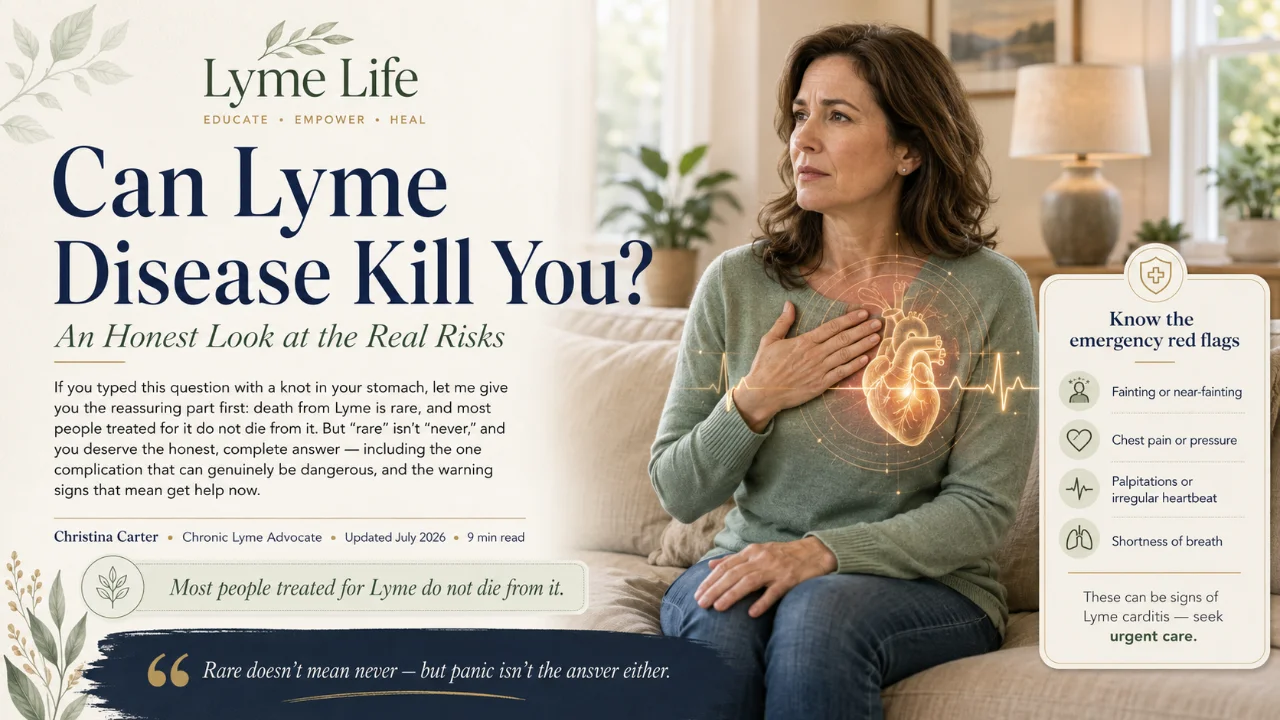
Red flags: when to get help now
Most palpitations are benign. But because Lyme carditis is in the mix, these signs mean stop reading and seek urgent or emergency care:
- Fainting or near-fainting with palpitations.
- Chest pain or pressure.
- Severe or new shortness of breath.
- A very slow pulse (heart block can slow the heart dangerously).
- A very fast or wildly irregular heartbeat that won't settle.
- Palpitations after a recent tick bite or bullseye rash — tell whoever sees you about the exposure, because acute Lyme carditis is time-sensitive and treatable.
None of that is meant to scare you away from living your life. It's the opposite: knowing the handful of signs that need fast action is exactly what lets you stop panicking over every ordinary flutter.
What to ask your clinician
Print this and bring it in:
- "Could this be Lyme carditis — and given my history, should we check my heart's electrical rhythm?"
- "Could dysautonomia or POTS explain my palpitations, especially when I stand?"
- "Should we consider co-infections like Bartonella or Babesia?"
- "What have we ruled out — thyroid, anemia, medications — before settling on anxiety?"
- "If it is Lyme-related, what's our plan to treat the cause, not just the symptom?"
If you're piecing this together, start with Lyme symptoms, then Lyme testing and how to get a doctor to take chronic Lyme seriously — because being heard is half the battle with heart symptoms especially.
And if your heart has been doing frightening things and no one will look past "anxiety," I remember that exact loneliness. I'd be glad to help you think through your next step.
Lyme & Heart Palpitations FAQ
Yes. Lyme can affect the heart in two very different ways. The first is Lyme carditis, where the Borrelia infection reaches heart tissue and disrupts its electrical signaling — an uncommon but potentially serious cause of a pounding, slow, or irregular heartbeat. The second, and more common in chronic Lyme, is dysautonomia — dysregulation of the autonomic nervous system that controls heart rate, causing a racing or fluttering heart, often worse on standing. Palpitations always deserve evaluation, since they can also come from causes unrelated to Lyme. Not medical advice.
Lyme carditis is what happens when Borrelia bacteria infect the heart, most often interfering with the electrical system that sets your heartbeat. Its hallmark is heart block — a slowing or interruption of the signal between the upper and lower chambers — which can cause a slow pulse, lightheadedness, fainting, or shortness of breath. It's uncommon and usually reverses with prompt antibiotic treatment, but it can be dangerous while active, so chest pain, fainting, or a very slow or very fast heartbeat need urgent care. Not medical advice.
It can. In chronic Lyme, a racing heart is frequently driven by dysautonomia and POTS, where the autonomic nervous system mismanages heart rate — classically sending it soaring when you stand up. Co-infections such as Bartonella and Babesia are strongly associated with this pattern. A racing heart can have many other causes too — thyroid problems, anemia, medication — so it should be evaluated rather than assumed. Not medical advice.
Most palpitations are benign, but Lyme is one reason not to brush them off. Lyme carditis, though uncommon, can cause heart block that is occasionally life-threatening if unrecognized — and treatable when it is. Seek urgent or emergency care if palpitations come with fainting or near-fainting, chest pain or pressure, severe shortness of breath, or a heartbeat that is very slow, very fast, or wildly irregular. Not medical advice.
Often, yes. Acute Lyme carditis typically resolves with prompt antibiotic treatment, and heart rhythm usually returns to normal. Palpitations driven by dysautonomia or co-infections tend to improve as the underlying infection and autonomic dysfunction are addressed, though this can take longer and usually involves supportive strategies alongside treatment. Because heart symptoms can have several causes, work with a clinician rather than assuming a single explanation. Not medical advice.
References & further reading
- Centers for Disease Control and Prevention (CDC) — Lyme Carditis. cdc.gov/lyme
- International Lyme and Associated Diseases Society (ILADS) — evidence-based guidelines and research. ilads.org
- MedlinePlus (U.S. National Library of Medicine, NIH) — Lyme Disease. medlineplus.gov
- Johns Hopkins Lyme Disease Research Center. hopkinslyme.org
Medical disclaimer: This article is for educational purposes only and reflects personal experience and general information. It is not medical advice, diagnosis, or treatment, and it does not replace consultation with a qualified healthcare professional. Heart symptoms can signal serious conditions and require prompt medical evaluation — if you have chest pain, fainting, severe shortness of breath, or an abnormal heartbeat, seek emergency care. Christina Carter is a patient advocate and educator, not a licensed medical provider. Individual results vary. Always consult a qualified clinician.