Babesia: Symptoms, Treatment & Why It Keeps You Sick
Can't catch a full breath? Waking up drenched in sweat? If you have Lyme and those sound familiar, Babesia — a malaria-like parasite that rides in on the same ticks — may be part of your picture. Here's an honest patient's guide.
When people treat their Lyme and still feel terrible, I always ask about two things first: their mood (that can point to Bartonella) and their breathing and sweats. Because if you're air-hungry and soaking your sheets at night, Babesia may be hiding underneath the Lyme — and it won't budge with Lyme's usual treatment.
Let me explain what Babesia is, the symptoms that give it away, and why it's such a common reason people don't fully recover.
Quick answer
What are the symptoms of Babesia?
Babesia symptoms often include air hunger (a feeling of needing to sigh or take a deep breath), drenching night sweats, chills, fatigue, headaches, and flu-like feelings. Because Babesia is a parasite that infects red blood cells, it can also cause symptoms related to reduced oxygen delivery. Symptoms overlap with Lyme and other conditions, so diagnosis requires a knowledgeable clinician and appropriate testing.
Key Takeaways
- Babesia is a malaria-like parasite carried by the same ticks as Lyme.
- Air hunger is the hallmark symptom — that can’t-catch-a-full-breath feeling.
- Drenching night sweats are another classic sign.
- Treating Lyme isn’t enough — Lyme antibiotics won’t touch a parasite.
- It needs anti-parasitic treatment and proper testing to find it.
What is Babesia?
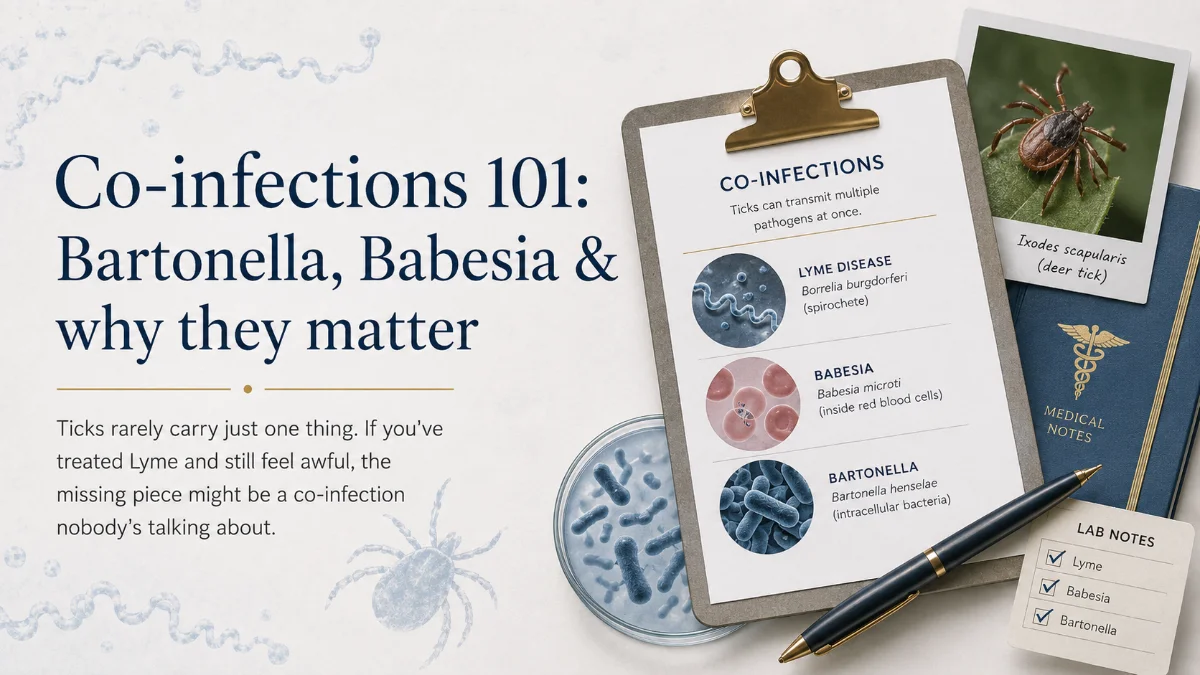
Here's the key thing that sets Babesia apart: it's a parasite, not a bacterium. It's often compared to malaria because, like malaria, it infects your red blood cells. It's carried by the same ticks that transmit Lyme, which is why the two so often travel together. The infection itself is called babesiosis.
That "parasite, not bacterium" detail isn't trivia — it's the whole reason Babesia needs completely different treatment from Lyme, which we'll get to.
Babesia symptoms
Babesia has some signature symptoms that can help distinguish it:
- Air hunger — needing to sigh or yawn for a full breath
- Drenching night sweats
- Chills and sweats, sometimes cyclical
- Deep fatigue
- Headaches
- Flu-like feelings, malaise
- Unexplained cough or shortness of breath
- "Waves" of feeling unwell
The two that make experienced clinicians think "Babesia" are air hunger and night sweats. If those ring true for you, they're worth flagging specifically.
Air hunger — the hallmark symptom
People search this one a lot, so let's be clear. "Air hunger" is that maddening feeling of not being able to get a satisfying, full breath — needing to sigh or yawn repeatedly — even when you're at rest and your lungs are fine. It's thought to relate to Babesia's effect on red blood cells and oxygen delivery.
Babesia & Lyme: why treating Lyme isn't enough
This is the crux. Because Babesia is a parasite, the antibiotics used for Lyme generally won't touch it. So you can dutifully treat your Lyme, feel some improvement, and still be dragged down by an untreated Babesia infection — because you were only fighting half the battle. It's one of the most common reasons for the "I treated my Lyme but I'm still sick" story, and a central theme in my guide to Lyme co-infections and why Lyme becomes chronic.
Testing & diagnosis
Like Lyme and Bartonella, Babesia can be hard to detect, and standard testing may miss it. Diagnosis often combines clinical judgment with specialized testing through experienced labs — more in my guide to the best Lyme tests. As always: a negative test doesn't necessarily rule it out, and an experienced clinician reading the whole picture matters more than any single result.
How Babesia is treated
Because it's a parasite, Babesia is treated with anti-parasitic / anti-malarial-style medications — not the standard antibiotics used for Lyme — often in combination and over an extended period. Some clinicians add herbal and supportive approaches alongside. It's individualized, it belongs with a knowledgeable clinician, and it is not something to attempt on your own.
If air hunger and night sweats are part of your story and no one has looked into Babesia, that's exactly the kind of gap I help people spot before their next doctor's visit.
Babesia FAQ
Often air hunger (needing to sigh or take a deep breath), drenching night sweats, chills, fatigue, headaches, and flu-like feelings. Because Babesia is a parasite that infects red blood cells, it can cause symptoms related to reduced oxygen delivery. Symptoms overlap with Lyme, so diagnosis needs a knowledgeable clinician and appropriate testing.
Because it's a parasite, not a bacterium, it's treated with anti-parasitic / anti-malarial-style medications rather than standard Lyme antibiotics — often combined and over an extended period. Some clinicians add herbal and supportive approaches. Treatment must be individualized and directed by a knowledgeable clinician, and results vary.
Babesia is a common co-infection carried by the same ticks that spread Lyme. When someone treats Lyme but doesn't fully recover, untreated Babesia is a frequent reason. Because it's a parasite, it usually won't respond to Lyme antibiotics, so it needs its own targeted treatment.
A hallmark Babesia symptom — feeling short of breath or needing to sigh or yawn to get a full breath, even at rest and without lung disease. It's thought to relate to the parasite's effect on red blood cells and oxygen delivery. Air hunger always warrants medical evaluation, since breathing symptoms can have many serious causes.
Yes — like Lyme and Bartonella, it can be difficult to detect and standard testing may miss it. Diagnosis often combines clinical judgment with specialized testing through experienced labs. A negative test doesn't necessarily rule it out, so evaluation by a clinician familiar with tick-borne infections is important.
References & further reading
- CDC — Babesiosis. cdc.gov/babesiosis
- International Lyme and Associated Diseases Society (ILADS) — evidence-based guidelines and research. ilads.org
- Centers for Disease Control and Prevention (CDC) — Lyme Disease. cdc.gov/lyme
- Johns Hopkins Lyme Disease Research Center. hopkinslyme.org
Medical disclaimer: This article is for educational purposes only and reflects personal experience and general information. It is not medical advice, diagnosis, or treatment, and it does not replace consultation with a qualified healthcare professional who knows your history. Babesia is a serious infection; breathing symptoms and air hunger require prompt medical evaluation and can have many causes. Christina Carter is a patient advocate and educator, not a licensed medical provider. Individual results vary. Always consult a qualified clinician for diagnosis and treatment.