Bartonella: Symptoms, the Telltale Rash & Why It Keeps You Sick
If you were treated for Lyme but never got well — especially if you battle anxiety, rage, foot pain, or strange stretch-mark-like rashes — Bartonella may be the missing piece. Here's a patient's honest guide to one of Lyme's most important co-infections.
Here's something that took me far too long to understand: "Lyme" is rarely just Lyme. So many people treat the Lyme and stay sick, never knowing that a co-infection was quietly driving their worst symptoms. Bartonella is one of the biggest culprits — and one of the most commonly missed.
If the word is new to you, or if you're wondering whether it explains what you're going through, let me walk you through it plainly.
Quick answer
What are the symptoms of Bartonella?
Bartonella symptoms can include fatigue, a characteristic rash that often looks like stretch marks, pain in the soles of the feet (especially in the morning), anxiety, irritability and mood swings, brain fog, swollen glands, sore throat, low-grade fevers, and neurological or psychiatric symptoms. Because these overlap with Lyme and other conditions, Bartonella is often missed. Diagnosis should be made by a knowledgeable clinician using clinical judgment and appropriate testing.
Key Takeaways
- Bartonella is a common Lyme co-infection and often the missing piece when treated Lyme never resolves.
- Hallmark clues: anxiety, rage, foot pain (especially mornings), and stretch-mark-like rashes (striae).
- It strongly affects mood and the mind — not just the body.
- It’s frequently missed because standard Lyme testing doesn’t catch it.
- It needs its own targeted treatment — Lyme antibiotics alone won’t clear it.
What is Bartonella?
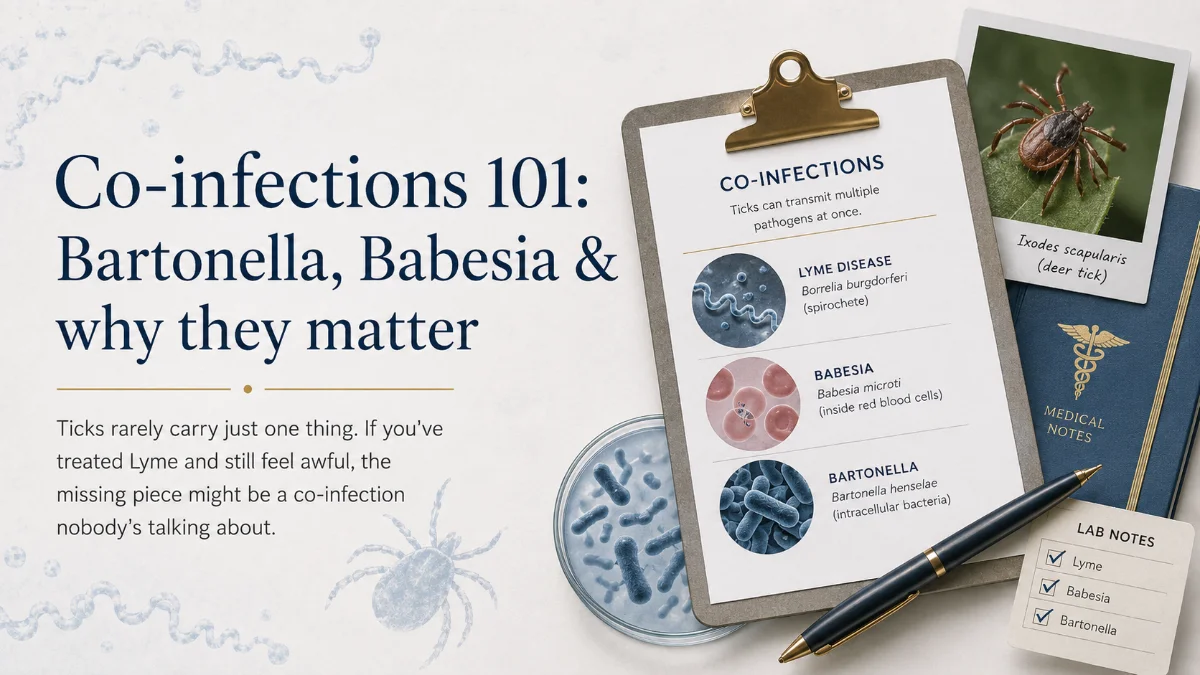
Bartonella is a type of bacteria — you may have heard of one form as the cause of "cat scratch disease." It's transmitted through several routes: ticks (which is why it travels with Lyme), but also cat scratches, fleas, and possibly others. In the tick-borne world, it's considered one of the most common co-infections alongside Lyme.
Bartonella symptoms
Bartonella has a somewhat distinctive fingerprint that can help it stand out from Lyme. Commonly reported symptoms include:
- Fatigue
- The telltale rash like stretch marks (see below)
- Pain in the soles of the feet, often worse in the morning
- Anxiety, irritability, rage, mood swings
- Brain fog and cognitive trouble
- Swollen glands, sore throat
- Low-grade fevers, night sweats
- Neurological & psychiatric symptoms
That neuropsychiatric side is a big deal, so it gets its own section below — it's one of Bartonella's most important and most missed features. Bartonella is also one of the infections most linked to POTS and dysautonomia — the racing heart and dizziness on standing that so many patients get told is "just anxiety."
The Bartonella rash (striae)
People search for this constantly, so here's the plain description: the rash most associated with Bartonella often looks like stretch marks — reddish, purplish, or brownish linear marks (called striae), sometimes appearing in places where ordinary stretch marks wouldn't form, and sometimes seeming to come and go.
Important: not everyone with Bartonella gets this rash, and a rash by itself doesn't prove infection. If you notice unexplained stretch-mark-like marks along with other symptoms here, that's worth showing a knowledgeable clinician — not self-diagnosing from a photo online.
Why Bartonella affects mood and the mind
This is the part I most want people to know, because it's so often missed: Bartonella is strongly associated with neuropsychiatric symptoms — anxiety, irritability, sudden rage, mood swings, and in some cases more serious psychiatric changes, especially in children. Families sometimes watch a child's personality change and are told it's purely psychiatric, when a tick-borne infection is fueling it.
I'm not saying every mood struggle is Bartonella — far from it. But when psychiatric symptoms appear alongside the physical pattern above, an evaluation by someone familiar with tick-borne infections can matter enormously.
Bartonella & Lyme: the missing piece
Here's why this page exists. When someone treats their Lyme and still isn't well, an untreated co-infection like Bartonella is one of the most common reasons. It's a major theme in my broader guide to Lyme co-infections and to why Lyme becomes chronic. You can't fully win a fight you don't know you're having.
Testing & diagnosis
Bartonella is notoriously hard to detect — standard testing misses it often, much like Lyme. Specialty labs and clinical judgment both play a role. I go deeper into the labs Lyme-literate doctors trust in my guide to the best Lyme tests (several of which also test for Bartonella). The key point: a negative test doesn't rule it out, and diagnosis leans heavily on an experienced clinician reading the whole picture.
How Bartonella is treated
Treatment usually involves targeted antimicrobial approaches that differ from Lyme's, often in combination and over an extended time, because Bartonella can be stubborn and persistent. It's highly individualized and belongs in the hands of a knowledgeable clinician; some people also use herbal and supportive approaches alongside medical treatment. This is very much not a DIY situation.
If you suspect Bartonella is the reason you never got better, that's exactly the kind of thing worth talking through — so you can bring the right questions to the right doctor.
Bartonella FAQ
Fatigue, a rash that often looks like stretch marks, pain in the soles of the feet (especially mornings), anxiety, irritability and mood swings, brain fog, swollen glands, sore throat, low-grade fevers, and neurological or psychiatric symptoms. Because these overlap with Lyme and other conditions, Bartonella is often missed — diagnosis needs a knowledgeable clinician.
It often resembles stretch marks (striae) — reddish, purplish, or brownish linear marks, sometimes where stretch marks wouldn't normally form. Not everyone with Bartonella gets it, and a rash alone isn't proof, so suspicious skin changes should be evaluated by a clinician.
Bartonella is one of the most common co-infections found with Lyme. It can be transmitted by ticks and by other routes like cat scratches and fleas. When someone with Lyme doesn't fully recover, untreated Bartonella is a frequent reason — which is why clinicians often evaluate for it as part of a comprehensive plan.
Usually targeted antimicrobial approaches that differ from Lyme's, often combined and over an extended period because it can be persistent. Treatment is individualized and should be directed by a knowledgeable clinician; herbal and supportive approaches are sometimes used alongside. Results vary, and self-treating isn't advised.
Yes — it's notable for neuropsychiatric symptoms like anxiety, irritability, rage or mood swings, and sometimes more serious psychiatric changes, particularly in children. These can be mistaken for a primary mental health condition, so evaluation by a clinician familiar with tick-borne infections can be important.
References & further reading
- CDC — Bartonella Infection. cdc.gov/bartonella
- International Lyme and Associated Diseases Society (ILADS) — evidence-based guidelines and research. ilads.org
- Johns Hopkins Lyme Disease Research Center. hopkinslyme.org
- Centers for Disease Control and Prevention (CDC) — Lyme Disease. cdc.gov/lyme
Medical disclaimer: This article is for educational purposes only and reflects personal experience and general information. It is not medical advice, diagnosis, or treatment, and it does not replace consultation with a qualified healthcare professional who knows your history. Bartonella is complex, frequently missed, and easily confused with other conditions; a rash or symptom pattern alone is not a diagnosis. Christina Carter is a patient advocate and educator, not a licensed medical provider. Individual results vary. Always consult a qualified clinician for diagnosis and treatment.