Mold + Lyme: The Connection No One Warned You About
You've treated the Lyme. You did everything right. And you're still on the floor. Here's a piece the standard playbook often misses: mold illness and Lyme are a vicious pair — and if mold is in the picture, treating Lyme alone may never get you well.
If you've been grinding away at Lyme treatment and still can't get traction — still exhausted, still reactive to everything, still foggy — I want to put something on your radar that changed the game for a lot of people I've worked with: mold.
Mold illness and Lyme overlap so completely, and feed each other so viciously, that missing the mold piece can keep you stuck for years while you blame yourself or the treatment. It's one of the most common "why am I not getting better?" answers in the whole Lyme world.
Quick answer
What is the connection between mold and Lyme disease?
Mold illness (often called CIRS, Chronic Inflammatory Response Syndrome) and chronic Lyme overlap heavily and can feed each other. Both drive chronic immune dysregulation and inflammation, share nearly identical symptoms, and lower the body's threshold for the other. Mold exposure can weaken immune function needed to fight Lyme, while a Lyme-burdened body has less capacity to clear biotoxins. Treating only one can leave a person stuck.
Key Takeaways
- Mold illness (CIRS) and Lyme are a vicious pair — if mold is in the picture, treating Lyme alone may never get you well.
- They look almost identical, which is why mold gets missed.
- They feed each other, keeping the immune system overwhelmed.
- Signs mold is your missing piece: you did everything right for Lyme and still crashed.
- Order matters — sometimes mold has to be addressed first (or alongside) for Lyme treatment to hold.
What is mold illness (CIRS)?
Mold illness — often discussed as CIRS, Chronic Inflammatory Response Syndrome — is what happens when biotoxins from water-damaged buildings (mold and its byproducts) trigger a chronic, dysregulated inflammatory response in susceptible people. Not everyone exposed gets sick; genetics play a real role in who can't clear these toxins efficiently. Roughly a quarter of people carry immune-gene variants that make them poor detoxers of these biotoxins — they're the ones who stay switched on long after exposure. For them, the immune system never stands down, driving the multi-system, hard-to-pin-down illness that sounds so eerily like chronic Lyme.
Why mold and Lyme look almost identical
Here's the trap. Mold illness and chronic Lyme share an enormous symptom overlap: crushing fatigue, brain fog, joint and muscle pain, headaches, mood changes, sensitivity to everything, and unrelenting inflammation. On the surface, you often can't tell them apart — which is exactly why one gets missed while the other gets all the blame. Many people are treated for Lyme for years while an unaddressed moldy home quietly keeps them sick, and just as many chase mold while an untreated infection smolders. The symptoms don't tell you which; the pattern and the testing do.
Why they feed each other
This is the vicious part. Both conditions hammer the same system — the immune system — and keep it stuck in overdrive (the same immune dysregulation I describe in the 3-layer framework). Mold exposure can weaken immune function, making it harder to fight Lyme and co-infections. Meanwhile, a body already overwhelmed by Lyme has less capacity to detox biotoxins. Each one lowers your threshold for the other. It becomes a loop: mold suppresses immunity → Lyme flares → the body's detox capacity drops → mold toxins build → immunity drops further. Treat only one, and the other keeps the fire burning.
you didn't fail.
You may be fighting on two fronts.
Signs mold might be your missing piece
- You've treated Lyme diligently and hit a plateau — or improve, then crash for no clear reason.
- Your symptoms change with location — better on vacation, worse at home or at work. (This is the single most telling clue — pay attention to it.)
- You live or work in a building with past water damage, leaks, a musty smell, or a basement or bathroom that's ever flooded.
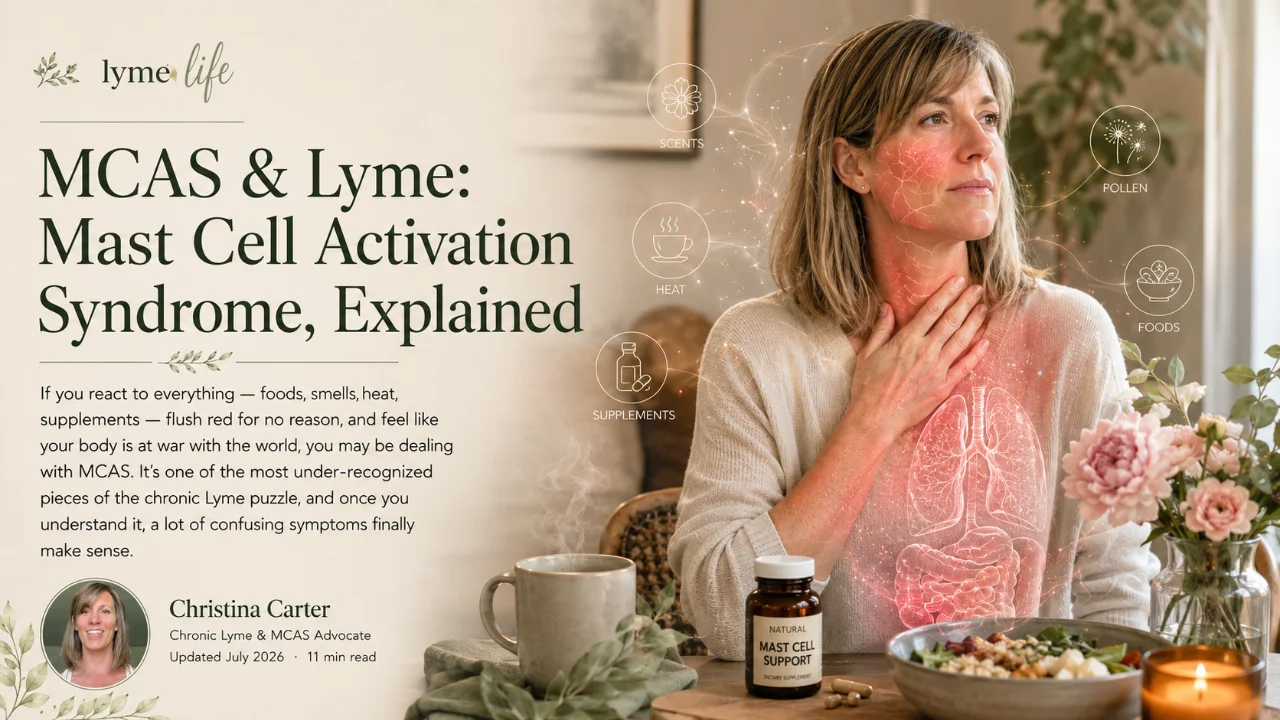
- You're reactive to everything — foods, chemicals, supplements, smells (a hallmark of MCAS / mast cell activation, which overlaps with immune dysregulation and anxiety).
- Others in your home or workplace also have unexplained symptoms — including pets.
- You feel noticeably worse in specific rooms or buildings, sometimes within minutes.
What to do about it
The single most important, non-negotiable step is getting out of ongoing exposure — you cannot out-treat a moldy environment while you're still living in it. Everything else is downstream of that. Beyond removing exposure, working with a practitioner who understands both mold and Lyme is key:
- Test both you and your environment. Your body (biotoxin and inflammatory markers) and your building (professional inspection, not just a hardware-store petri dish) — you need both halves of the picture.
- Open your drainage pathways first. Gut, liver, kidneys, lymph, sweat — mobilizing toxins before your exits are open just makes you sicker. This is where a lot of people go wrong.
- Support detox and binders as guided by your practitioner, in a deliberate sequence rather than all at once.
- Calm the overactive immune response — the same terrain work that helps chronic Lyme (anti-inflammatory support, nervous-system regulation) helps here.
Mold first or Lyme first?
This is the question people always ask, and while the answer is individual, there's a widely-shared principle worth knowing: address the environment and drainage before you go hard at either infection. Many experienced practitioners find that if mold is a major driver, Lyme treatment simply won't "take" until the mold burden and exposure are handled — the immune system is too overwhelmed to respond. For others, Lyme is clearly the primary fire. The practical takeaway: if you're stuck, get the mold question answered rather than assumed, and sequence the work with someone who treats both. Guessing — or treating them blindly at the same time — is how people spin their wheels for years.
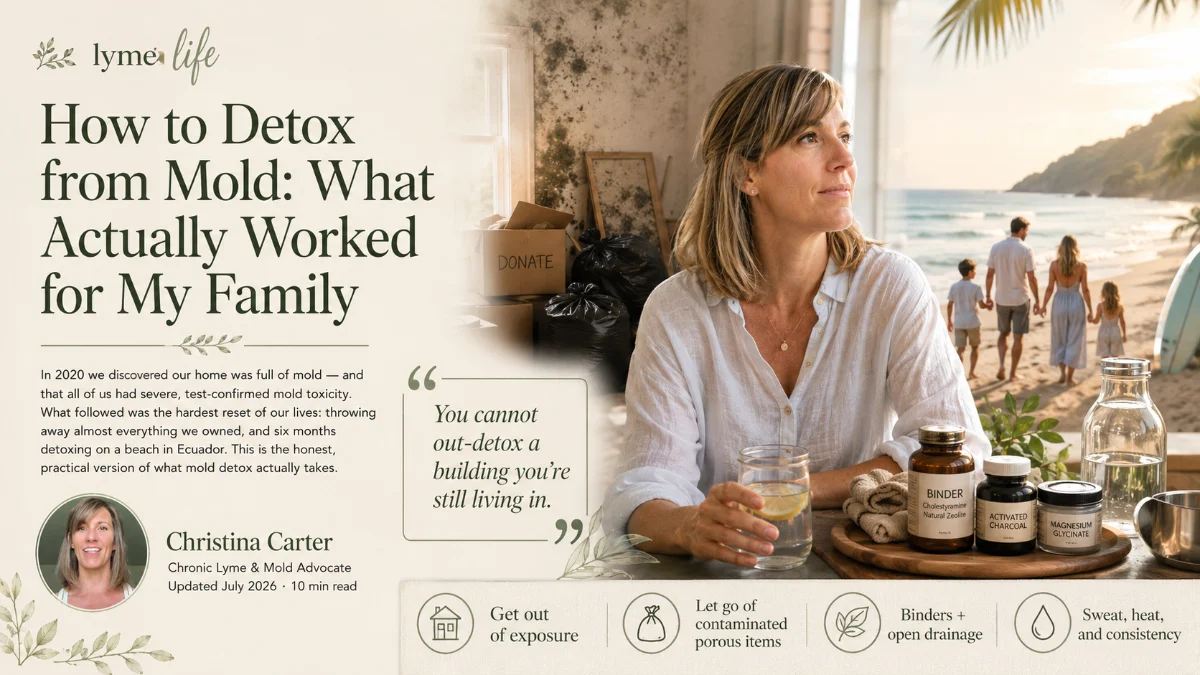
I'll tell you exactly how far this went for my own family, because I don't ask anyone to do something I haven't. In 2020, during lockdown, we discovered our house was full of mold — and testing confirmed all of us had severe mold toxicity. It was so extensive that we ended up throwing away about 90% of everything we owned, keeping only what was truly cleanable: metal and glass. Then, in January 2021, we relocated to a small fishing village just off the beach in Ecuador for six months — deliberately somewhere hot, so we could exercise, sweat, and take binders every single day while we healed. If you want the full practical playbook, I wrote it up in how to detox from mold.
If you've done all the "right" Lyme things and you're still down, please don't conclude you're the problem. It may simply be that no one looked at the whole battlefield. I'm glad to help you think through whether mold belongs in your picture.
Mold & Lyme FAQ
Mold illness (CIRS) and chronic Lyme overlap heavily and feed each other — both drive immune dysregulation and inflammation, share nearly identical symptoms, and each lowers the body's threshold for the other. Treating only one can leave you stuck.
Clues: plateauing despite good Lyme treatment, improving then crashing, symptoms that change with location, a water-damaged or musty building, reactivity to many foods/chemicals, and others in the building also sick. Worth investigating with a knowledgeable practitioner.
It's very hard — removing ongoing exposure is the essential first step; you can't out-treat a moldy environment. Recovery then involves testing, detox and drainage support, and calming the immune response, guided by a knowledgeable practitioner.
They overlap almost completely — fatigue, brain fog, pain, headaches, mood changes, sensitivities, and inflammation appear in both. That's why one is often missed while the other gets blamed.
References & further reading
- Centers for Disease Control and Prevention (CDC) — Lyme Disease. cdc.gov/lyme
- International Lyme and Associated Diseases Society (ILADS) — evidence-based guidelines and research. ilads.org
- MedlinePlus (U.S. National Library of Medicine, NIH) — Lyme Disease. medlineplus.gov
Medical disclaimer: This article is for educational purposes only and reflects personal experience and general information. It is not medical advice, diagnosis, or treatment, and it does not replace consultation with a qualified healthcare professional. Christina Carter is a patient advocate and educator, not a licensed medical provider. Always consult a qualified professional about your health, and never delay or disregard medical advice because of something you read here.