Is Lyme Disease Contagious?
It's one of the first fears that hits a family after a diagnosis: can I give this to the people I love? Can my partner catch it? My kids? The short answer will let you exhale — but the full answer is worth understanding, because there's a lot of scary misinformation out there.
When I was at my sickest, one of the quiet terrors I carried had nothing to do with my own body. It was the fear that I might be a danger to my family — that a hug, a shared cup, a kiss goodnight could somehow pass this nightmare on to my kids. If that fear is sitting on your chest right now, let me lift it off you as quickly as I can.
Lyme disease is not contagious the way a cold or the flu is. You cannot catch it by being near someone, hugging them, sharing a meal, or living in the same house. Lyme is spread by the bite of an infected tick — that's the route that matters for the everyday fears most families have. There is one area (intimate contact) where I think honest caution is wise, and one exception I take very seriously (pregnancy), and I'll cover both plainly below.
Quick answer
Is Lyme disease contagious?
Lyme disease is not considered contagious in the way a cold or flu is. It is transmitted primarily through the bite of an infected tick, not through casual contact. There is no good evidence that you can catch Lyme from being near, touching, hugging, or sharing a household with an infected person. The reason several family members often have Lyme is usually shared exposure to the same tick habitat, not person-to-person spread.
Key Takeaways
- You can’t “catch” Lyme from another person like a cold — it’s spread by tick bites, so exhale.
- Whole families often have it because they were bitten in the same environment, not because they infected each other.
- The one exception worth watching is pregnancy — an untreated mother can pass Borrelia to her baby, so treatment matters.
- Intimate transmission isn’t proven, but I don’t say “never” — the science is thin and Borrelia resembles syphilis; caution is reasonable.
- Protect your family by preventing bites — checks, clothing, and prompt tick removal, not by fearing each other.
How Lyme actually spreads
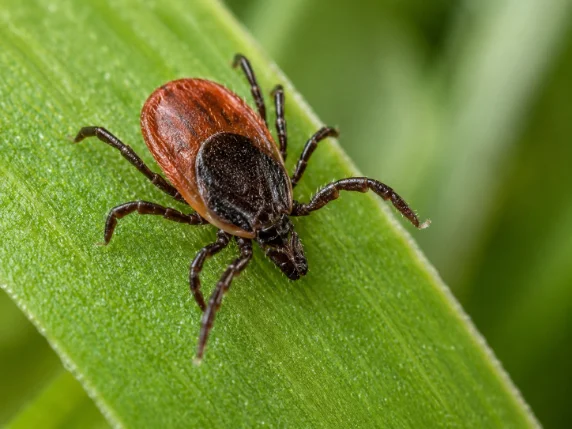
Lyme disease is caused by a corkscrew-shaped bacterium (a spirochete, Borrelia burgdorferi and related species) that lives in certain ticks. When an infected tick attaches and feeds long enough, it can pass the bacteria into your bloodstream. That's the mechanism. No tick, no transmission — which is why prevention is all about ticks, not about people.
Ticks often carry more than Lyme, too. A single bite can deliver co-infections like Babesia and Bartonella alongside the Lyme bacterium. But again — the delivery vehicle is the tick, not the person sitting next to you.
"Then why does my whole family have it?"
This is the question that makes people certain Lyme must be catching. I understand completely — my own family has multiple people who've had Lyme. But here's the thing: shared diagnosis usually means shared exposure, not contagion.
Families do life together. You hike the same trails, garden in the same yard, walk the same dog through the same tall grass, camp in the same woods. If ticks are in your environment, everyone moving through that environment is at risk of being bitten. It's not that one family member gave it to another — it's that the same habitat bit more than one of you. When you understand that, the pattern stops being spooky and starts being logical.
The questions everyone actually asks
Let me answer the specific worries head-on, because these are the exact ones people are too nervous to ask out loud.
Can I catch Lyme from kissing or saliva?
Officially, there's no proven transmission through kissing or saliva, and I don't want anyone terrified of everyday affection with the people they love. But I'll be honest with you: at least two studies have detected Borrelia DNA in human saliva, and while that's early, unvalidated evidence — genetic material, not proof of live, infectious bacteria — Lyme science is so far behind that “no proof yet” carries a lot less comfort than it should. Given how often this disease has been underestimated, I land on gentle caution rather than blanket reassurance: everyday family affection is very likely fine, but this isn't a closed question.
Is Lyme an STD? Can it spread through sex?
Officially, Lyme is not classified or tracked as a sexually transmitted disease, and public-health agencies say there's no conclusive proof it spreads sexually. But I won't pretend the science is settled, because it isn't. The Lyme bacterium (Borrelia) is a spirochete — a close cousin of the syphilis spirochete, which is sexually transmitted — and Borrelia has been detected in semen and vaginal secretions in at least one study. There's no large, definitive study proving sexual transmission happens, and none proving it doesn't. Given that honest uncertainty, my personal view is simple: this is a reasonable place to be cautious rather than to assume you're safe. See below for why.
Can I catch it from coughing, sneezing, or being nearby?
No. Lyme isn't a respiratory infection — it doesn't spread through the air, coughing, sneezing, or casual contact. You can care for a sick loved one without fear of catching it that way.
What about sharing a household, towels, or a bathroom?
Ordinary household life — shared bathrooms, towels, laundry, dishes — is not a known way to transmit Lyme. (As a general safety practice, blood donation is discouraged during active infection, but that's routine caution, not everyday household risk.)
Why I don't say "never" about intimate contact
I want to be straight with you here, because this is where a lot of Lyme websites overpromise. The official line — "Lyme is not sexually transmitted" — is based on the fact that there's no large, conclusive study proving it is. That's true. But the absence of proof is not the same as proof of absence, and the biology gives me enough pause that I won't tell you it's impossible.
Here's the part worth understanding: the Lyme bacterium, Borrelia, is a spirochete — a corkscrew-shaped bacterium in the same family as Treponema pallidum, the organism that causes syphilis. Syphilis is, of course, one of the most well-known sexually transmitted infections in the world. And the two are strikingly similar:
- Both are spirochetes on the same branch of the bacterial family tree; Borrelia is actually the more complex and capable of the two.
- Both move the same way — and Borrelia can actually corkscrew through thicker fluids than syphilis can.
- Both have been detected in semen and vaginal secretions. Borrelia DNA has also turned up in saliva in at least two studies — early, unvalidated evidence (DNA, not confirmed live bacteria), but not nothing given how far behind Lyme research runs.
- Both are exceptional at penetrating the body — crossing barriers, including the blood-brain barrier, that stop almost every other organism.
- Both can invade the placenta and reach an unborn child.
- Late-stage neurosyphilis and late-stage neurological Lyme look remarkably alike.
In a small but real 2014 study, researchers reported finding live Borrelia in the genital secretions of Lyme patients — which is what you'd need for sexual transmission to be plausible. It didn't prove transmission happens between partners, and mainstream guidance still says the evidence isn't there. But it's enough that reasonable, science-minded people land on caution.
Here's the question I'd gently ask: if a partner had Lyme, would you have unprotected sex on the strength of the fact that a conclusive study hasn't been done — or would you rather be prudent while the science catches up?
I'm not saying this to frighten anyone or to imply people with Lyme are dangerous — they are not. I'm saying it because you deserve the honest, uncertain truth rather than false reassurance. For the everyday fears — hugs, cups, living together — you can truly relax. For intimate contact, this is your information; the choice about how cautious to be is yours to make with your partner, and ideally your doctor.
Pregnancy: the exception I take most seriously
I was pregnant with my son while I had active, untreated Lyme — before I understood what was making my whole family sick. My son Cameron was later diagnosed with congenital Lyme. I will carry the weight of not knowing, back then, for the rest of my life. I'm telling you the most painful part of my story because I would give anything for another mother to catch this sooner than I did.
Here's the crucial hope inside that hard truth: this is about untreated infection, and it is largely addressable with prompt, proper care. With good medical management during pregnancy, outcomes are generally good — which is precisely why awareness matters so much. If you're pregnant and have Lyme, think you might, or are even planning a pregnancy, please don't navigate it from a search bar. Work closely with a knowledgeable, Lyme-literate clinician who takes tick-borne infection in pregnancy seriously. Breastfeeding is another area to discuss directly with your provider rather than guess about.
None of this is meant to frighten expectant mothers or to blame anyone — I of all people would never do that. It's meant to make sure you get the one thing I didn't have: the information, early enough to act on it.
Is Lyme hereditary?
No — Lyme is an infection, not an inherited trait. You don't pass it down in your genes the way you pass down eye color; it's acquired from a tick. That said, families do share genetics that can shape how they respond to it — how well they detoxify, how their immune systems behave. It's part of why two people bitten by the same kind of tick can end up very differently sick. But the illness itself is caught, not inherited.
What actually protects your family
Here's the empowering flip side: because Lyme comes from ticks, protecting your family is about the outdoors, not about isolating the person who's sick. The energy you might have spent worrying about contagion is far better spent here:
- Do daily tick checks after time outside — especially on kids, and in warm, hidden spots (scalp, behind ears and knees, waistband, armpits, groin).
- Know what to do the moment you find one. Prompt, correct removal matters — here's exactly what to do after a tick bite, including saving the tick for testing.
- Dress and treat for tick country — light clothing, tucked-in layers, and appropriate repellents when you're in tick habitat.
- Watch your pets. Dogs bring ticks indoors; keep them protected and check them too.
- Learn the early signs so a new bite gets caught fast — see the Lyme rash and early Lyme symptoms. In children, symptoms can look a little different — here's Lyme in kids.
Remember too that having had Lyme doesn't make anyone immune — a family member who recovered can still be bitten and infected again, which is really about reinfection from a new tick, not catching it from you.
If your family is navigating Lyme and you're frightened and full of questions, you don't have to sort the real risks from the myths alone. I've lived this with my own family, and I'm glad to help you find your footing.
Is Lyme Contagious? FAQ
Not the way a cold or flu is. Lyme is transmitted primarily through the bite of an infected tick, not casual contact. There's no good evidence you can catch it from being near, touching, hugging, or sharing a home with an infected person. When several family members have Lyme, it's usually shared exposure to the same tick habitat — not person-to-person spread.
There's no reliable evidence Lyme spreads directly person-to-person through everyday contact. You can't catch it from hugging, sharing food or drinks, coughing, or sneezing. It's spread by infected ticks. Multiple family cases typically trace back to the same tick-filled environment.
Officially, no — Lyme isn't classified or tracked as an STD, and authorities say there's no conclusive evidence of sexual transmission. But the science isn't settled. Borrelia is a spirochete closely related to the syphilis bacterium (which is sexually transmitted), and it has been detected in semen and vaginal secretions. No large study proves transmission between partners happens, and none proves it can't. Given that uncertainty, many people choose to be cautious about intimate contact rather than assume there's no risk. Not medical advice — talk it through with your clinician.
There's no proven transmission through kissing or saliva, and everyday family affection is very likely fine. But at least two studies have detected Borrelia DNA in human saliva — early, unvalidated evidence (genetic material, not confirmed live bacteria), with no person-to-person spread demonstrated. Because Lyme science lags so far behind, I lean toward gentle caution rather than calling it a closed question. Not medical advice.
Yes — this is a documented exception and should be taken seriously. Untreated Lyme in pregnancy can carry risk to the baby, including transmission of the infection. The key word is untreated: with prompt, appropriate medical care, outcomes are generally good, which is why early awareness matters so much. Any woman pregnant with Lyme, who thinks she may be infected, or planning a pregnancy should work closely with a Lyme-literate clinician. Not medical advice — individual care must be guided by a qualified provider.
Lyme is an infection, not an inherited condition, so it isn't passed down genetically. Families can share genetic traits affecting detox and immune response, which may influence how sick different people get — but the infection itself is acquired from ticks, not inherited.
References & further reading
- Centers for Disease Control and Prevention (CDC) — Lyme Disease. cdc.gov/lyme
- International Lyme and Associated Diseases Society (ILADS) — evidence-based guidelines and research. ilads.org
- MedlinePlus (U.S. National Library of Medicine, NIH) — Lyme Disease. medlineplus.gov
- Johns Hopkins Lyme Disease Research Center. hopkinslyme.org
Medical disclaimer: This article is for educational purposes only and reflects personal experience and general information. It is not medical advice, diagnosis, or treatment, and it does not replace consultation with a qualified healthcare professional. Questions about transmission, pregnancy, breastfeeding, and treatment must be decided with a qualified clinician who knows your history. Christina Carter is a patient advocate and educator, not a licensed medical provider. Individual results vary. Always consult a qualified clinician.